Somebody in the group chat says "shall we just get a takeaway", and four messages later you are holding the phone. Two people have told you exactly what they want. Three have said "whatever you're having". One has not read any of it yet and will surface at the worst possible moment.
You are now doing a job nobody explained: turning six sets of preferences into one order that has to arrive at one door, at one time, still hot.
An order that works for six is a different shape from six orders going to the same address, and the shape is quick to learn.
Your order leaves the kitchen in one piece
Whatever the six of you choose, the restaurant sees one ticket. The kitchen works backwards from the slowest thing on it so that everything is ready at roughly the same moment, and then it all goes into the same bags and the same car. Nothing you ordered travels on its own.
That is good news for the curry and bad news for the chips. A large container of something saucy is still properly hot twenty minutes later, because it has relatively little surface for the heat to escape through compared with what is inside it. A small box is nearly all surface. Order for six as twelve little boxes and you have built a meal that cools fast.
The basket
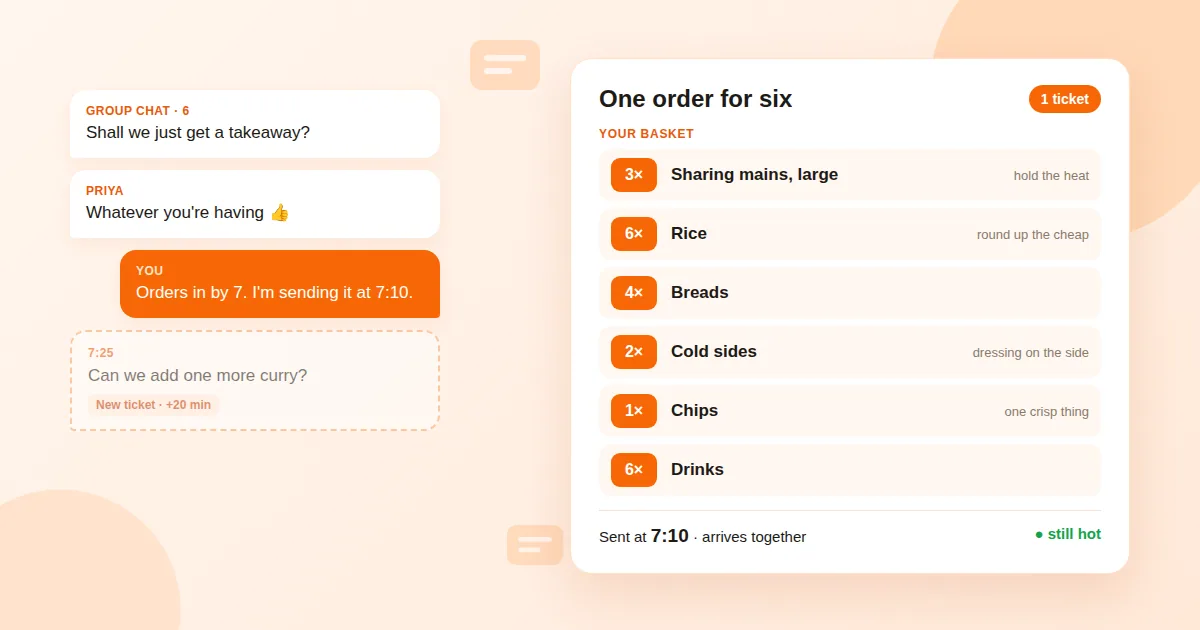
Here is an order for six from a mixed menu, written out the way it would actually go in. Yours will have completely different dishes in it — the shape is the part worth copying.
3 × sharing mains, large
6 × rice
4 × breads
2 × cold sides, dressings on the side
1 × portion of chips
6 × drinks
Four judgement calls are doing the work there.
Fewer dishes, bigger ones. Three large mains between six beats six individual ones: they hold heat, they usually cost less a head, and they turn dinner into something people pass across the table rather than six separate meals eaten in the same room. The dish everyone secretly wants gets ordered twice, not six times.
One crisp thing, not four. Chips, batter, spring rolls, samosas — pick the one the group will actually fight over and let the rest of the order be things that travel well. If two or three crisp things are non-negotiable, that is the argument for collecting rather than delivering.
Dressings and sauces separate wherever the menu offers it. A salad that travels dressed arrives as a different and sadder salad.
Round up the cheap things, not the expensive ones. Extra rice and an extra bread cost very little, cover the person whose eyes were bigger than expected, and are what you will be glad of. An extra main is how a group order quietly gets expensive and ends up half in the fridge.
Put it in once
The second place this goes wrong has nothing to do with what you chose. You send the order at ten past seven. At twenty-five past, someone who has finally read the chat asks whether you can add one more curry and a rice.
That addition is not a line on your order. It is a new ticket, starting from the beginning, in the busiest hour of the kitchen's week. Either it is cooked separately and turns up twenty minutes after everything else, or your whole delivery waits for it. Neither is what anyone wanted.
So set a deadline before you open the menu. Orders in by seven, I'm sending it at ten past. Five minutes of nagging in a group chat is worth twenty minutes of standing around later. And if the late request arrives anyway, saying no is usually the kinder answer — eating twenty minutes after everyone else is not much fun either.
Two things to sort before you press order
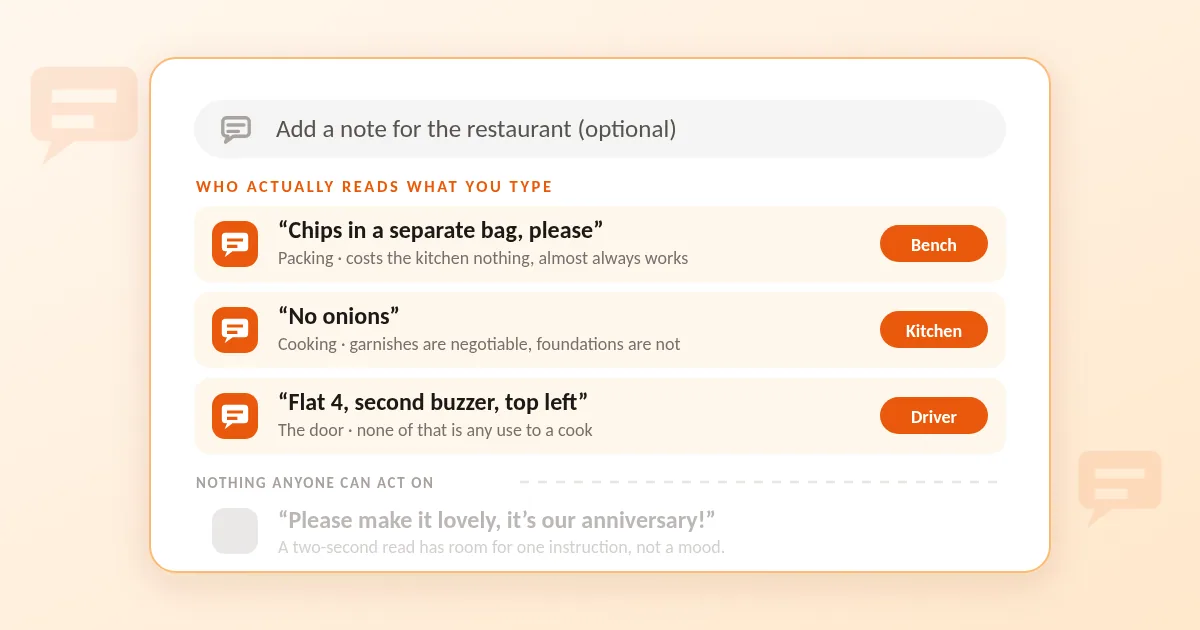
An allergy never goes in the notes box. If someone at the table has one, phone the restaurant before you order, and ask what is in the dish rather than whether they can make it without — a kitchen can leave the nuts off the top and still be using a paste with nuts in it. The notes box is a line of small type read for about two seconds by whoever is packing. It is a good place for "chips in a separate bag" and completely the wrong place for anything medical.
Settle the money before the food arrives, not after. Divide the total by the number of people eating and put that number in the chat while everyone is still cheerful about dinner. Whoever placed the order should not also spend Saturday chasing four payments.
It will not be perfect, and that is worth knowing
A large mixed order at half past seven on a Friday is close to the hardest thing a small kitchen does all week. Even done well, the chips will be softer than they were in the fryer, and one dish will be cooler than the rest because it was ready first and waited politely for the others. No amount of basket-building fixes that.
What does fix a surprising amount of it is going earlier. Two identical orders from the same kitchen, forty-five minutes apart, are not the same meal — the queue is shorter, the driver's run is shorter, and your ticket is in front of the kitchen rather than ninth in a pile. If your group wants to eat at seven, order at half six.
Where FoodCiti fits
FoodCiti restaurants take orders through their own ordering page, so a long order for six lands on the kitchen's screen as written instead of being read down the phone with the fryers going. Collection sits on the same menu if you would rather walk down and keep the chips crisp. There is a notes box for the things worth saying, delivery is free over £15 — which a table of six clears without trying — and you can watch the order through, so you know when to get the plates out.