Somewhere in the back of a restaurant, your order comes out of a printer on a strip of paper about eight centimetres wide. Your note is on it — one line of small type, under the dishes, in the same font as everything else. Someone reads that strip for about two seconds, in a hot room, with four more tickets behind it.
Everything worth knowing about the notes box follows from that. Most of us treat it as a wish. It works far better as an instruction — and only if you know who is holding the paper when your line gets read.
Your note has one reader, and it is not "the restaurant"
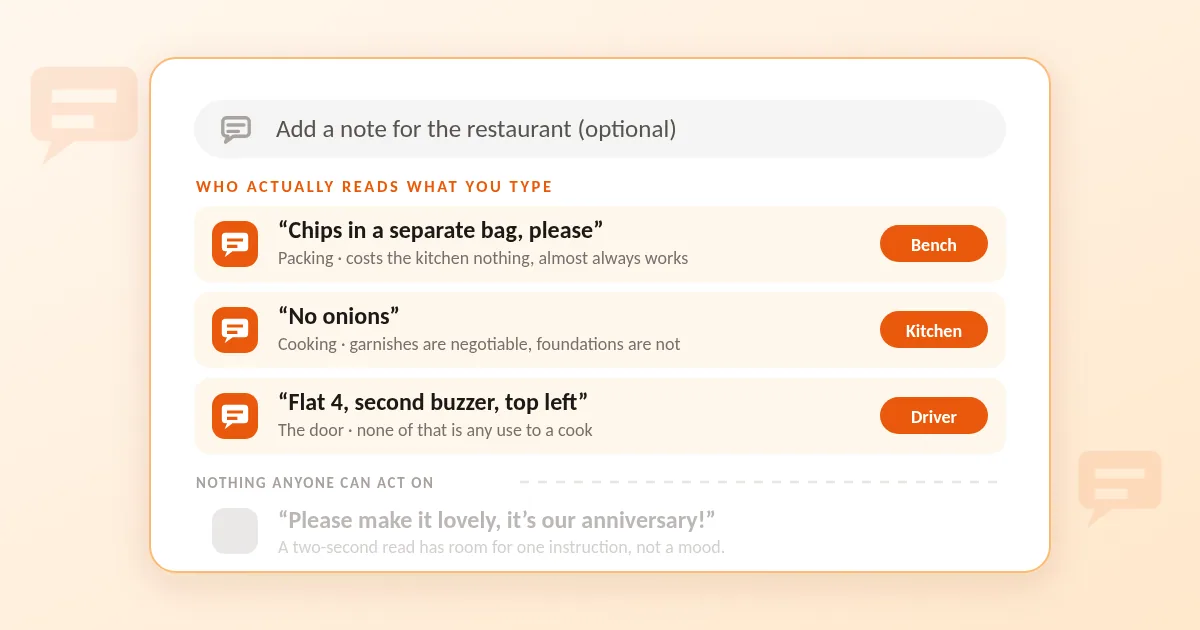
Three different people touch your order: whoever cooks it, whoever bags it, whoever drives it. Almost every note you could write belongs to exactly one of them, and it does nothing unless it reaches that one. So the question before you type is not what would I like, but who has to do this, and are they even in the room?
The notes that almost always work are about the bag
Packing requests are the cheapest thing you can ask for and hardly anybody uses them. They change nothing about the cooking and cost the kitchen nothing, and they get acted on by the one person holding your ticket and your bag at the same moment.
Chips kept away from anything steaming. Sauce on the side. No cutlery. Two bags instead of one if you are carrying it up a flight of stairs.
The chips one earns its ten seconds on its own — fried food starts losing its texture the moment it is sealed next to something hot and wet, which is most of what people mean when they say the food arrived cold.
The ones about the cooking are a coin toss, and that is not the kitchen being difficult
"No onions" depends entirely on where the onions are.
If they go in at the end, it is easy and nobody minds. If they are in a base sauce made in a twelve-litre pot at four in the afternoon, there is no version of that dish without them, and no amount of politeness at 7.40 changes it. The same goes for a marinade applied yesterday, a stock that has been going since lunch, a dough proved this morning.
The rough rule is that garnishes are negotiable and foundations are not. "Extra chilli" usually works. "Mild, please" usually works. "No coriander" usually works. "No garlic" often cannot, for the pot reason.
Write it anyway — but order something you would still be happy to eat if it turns up exactly as the menu describes it. If you would not be, what you have is not a note. It is a question, and questions belong on the phone before you order rather than in a box after.
An allergy never goes in the box
This is the one piece of advice here that is absolute.
A free-text field is not an allergy declaration. It is read quickly, by someone who may be new, in the middle of a service, and you get no confirmation that anybody saw it.
If someone eating is allergic, phone the restaurant before you order and say the word out loud. Ask what is actually in the dish, rather than whether they can make it without. A kitchen that answers precisely, and tells you what shares a fryer, is one you can order from. A kitchen that hesitates or says it should be fine has just told you what you needed to know. Put the note in the box as well, by all means — just never as the first line of defence.
Some of what you type never reaches the kitchen at all
Flat numbers, gate codes, a buzzer that has not worked since March, ring rather than knock, leave it with number 12. None of that is any use to a cook. It is for the driver, and the driver is not reading the kitchen's ticket.
If the ordering page gives you a separate box for delivery instructions, that is where those belong. If it doesn't, write them anyway — then answer your phone, because a driver who can call you is worth more than any sentence you can type.
Write it like a ticket, not like a sentence
Under ten words. One instruction. Something to do, rather than something you feel.
"We always find the chips go a bit soggy so if it's not too much trouble…" → "Chips in a separate bag, please."
"Not too spicy if possible" → "Mild — one of us is a child."
"Flat 4" → "Flat 4, second buzzer, top left."
"Please make it lovely, it's our anniversary!" → leave it blank.
Two instructions roughly halve the odds of either being followed. If you have three things to say, pick the one you would actually notice missing. And some things get ignored for good reason: paragraphs, jokes, negotiation about a free drink, "extra crispy" on something that was never fried, "please hurry". A two-second read has room for one thing.
The honest limit
A note is a request, not a contract. At half past seven on a Friday a busy kitchen will miss some of them, and the busier the restaurant, the more likely that is. Nobody is going to ring you to apologise about the onions.
Which is the real argument for keeping it short. Ten words aimed at the right person survive a two-second read. A polite paragraph does not.
Where FoodCiti fits
There is a notes box on every order, and because you are ordering from the restaurant's own page rather than through a middleman, what you write has fewer hands to pass through on its way to the bench.
Real-time tracking, so you are at the door instead of behind it. Collection on the same menu as delivery. Free delivery over £15. And ORVO, if you would rather say the order out loud than type any of it.
One short line, aimed at the right person, is the cheapest upgrade available on a takeaway. Most boxes go out empty.
See task progress for longer tasks.
foodciti-blog-hero-order-notes.pngfoodciti-blog-hero-order-notes.svgFoodCiti-Blog-Order-Notes.md
Foodciti