Every reporting screen in hospitality opens on the same list. Top sellers, this month, ranked by units. It is the first thing anyone looks at and the last thing anyone acts on, because it says something you already knew: the cheap, fast thing at the top of the menu sells the most.
Units sold tells you what people ordered. It does not tell you what it cost you to make, and it says nothing at all about the thing you are actually short of on a Friday night, which is not money and not customers. It is minutes.
So take one week of sales and sort the same list three different ways. That is what menu engineering amounts to in practice. The order changes twice, and the second change is the one worth acting on.
The list, sorted the way the report shows it
Six dishes from one week in an illustrative grill house. The figures below are made up to be worked through, not benchmarks — yours will be different, and the point is the method, not the numbers.
Sorted by units sold, highest first: chips (300), chicken wrap (260), chicken shish (210), lamb shish (96), mixed grill (48), sea bass (22).
Nothing surprising, and nothing to do about it. Chips sell. This is the list that never changes and never tells you what to change.
The two columns the report does not have
Add the first one from your own recipe costings: gross margin per unit — the selling price minus what the ingredients in that portion actually cost you. If you have never weighed a portion, that number is a guess, and it is usually a generous one. Weigh ten before you trust it.
Add the second one with a timer: hands-on kitchen minutes per unit. Not how long it sits on the grill — how long a pair of hands is committed to it and cannot be doing anything else. Time the same dish three times during a normal service and take the middle number. It takes one Friday to collect all six.
Dish | Units | Price | Food cost | Margin | Minutes |
|---|---|---|---|---|---|
Chips | 300 | £3.00 | £0.55 | £2.45 | 0.5 |
Chicken wrap | 260 | £6.50 | £2.10 | £4.40 | 1.5 |
Chicken shish | 210 | £9.50 | £3.20 | £6.30 | 3.0 |
Lamb shish | 96 | £12.50 | £5.40 | £7.10 | 4.0 |
Mixed grill | 48 | £17.50 | £7.90 | £9.60 | 9.0 |
Sea bass | 22 | £14.00 | £6.30 | £7.70 | 7.0 |
That is 936 dishes and, at those timings, 2,140 minutes of hands-on kitchen work — just under 36 hours across six items.
Sort two: by the cash it actually brought in
Multiply margin by units and the list rearranges itself.
Chicken shish comes top at £1,323, ahead of the wrap at £1,144, with chips third at £735. Lamb shish is fourth at £681.60, the mixed grill fifth at £460.80, sea bass last at £169.40. Six dishes, £4,513.80 of gross margin in a week.
This sort is more honest than the first one and it is where most people stop. Chips dropped from first to third; the chicken shish, third by units, is the biggest earner on the menu. Worth knowing. Still not quite actionable, because it treats a minute of kitchen time as free, and at 7.40pm it is the most expensive thing you own.
Sort three: by cash per minute of kitchen time
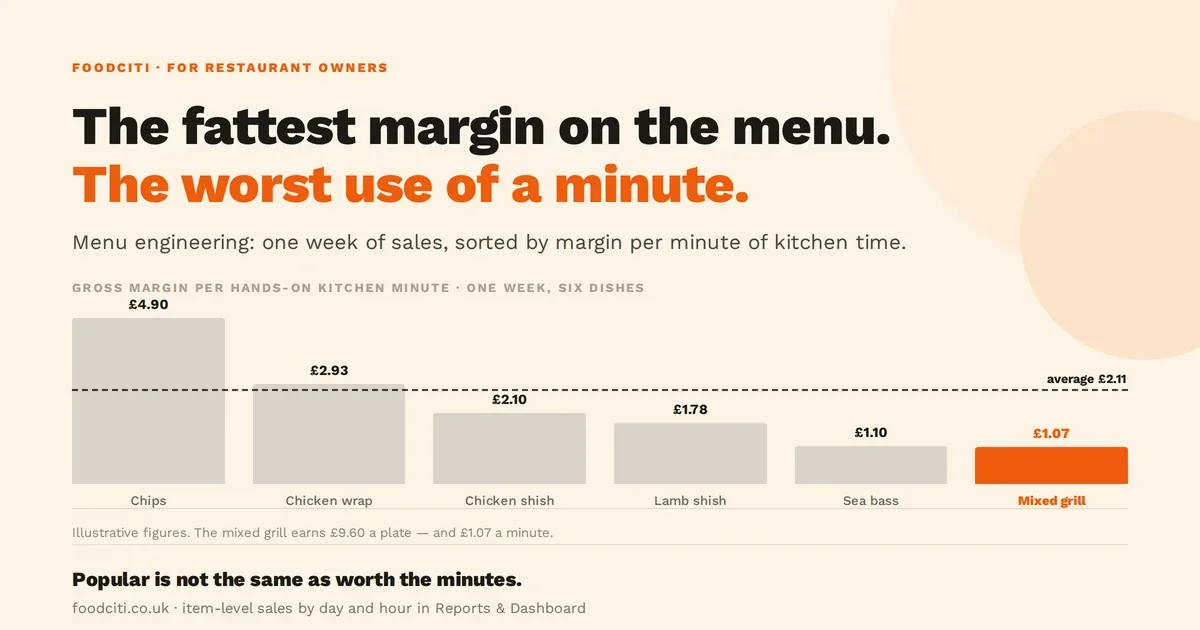
Divide the margin by the minutes and the list rearranges itself a second time, harder than the first.
Chips earn £4.90 a minute. The wrap earns £2.93. Chicken shish £2.10, lamb shish £1.78 — and then the two dishes at the bottom, sea bass at £1.10 and the mixed grill at £1.07. The average across all six is £2.11 a minute.
Look at what happened to the mixed grill. It has the fattest margin on the menu — £9.60 a plate, nearly four times the chips — and it is the worst use of a minute in the building. Forty-eight of them took 432 minutes, or a little over seven hours of hands-on work last week, and returned £460.80. The chicken shish took 630 minutes and returned £1,323. Same kitchen, same week, roughly twice the return on a minute.
That is the number the top-sellers list is hiding. Not which dish is popular. Which dish is quietly buying up your Friday.
What this list is not
It is not a cut list. Two things stop you acting on the bottom of it directly.
The first is that demand does not transfer. Take the mixed grill off and you do not get forty-eight chicken shish instead — you get some of them, and some of those tables order somewhere else, and you will not know the split until you have done it. The second is that the slow, expensive dishes are often why the table of six came in at all. One person orders the mixed grill and five people order around it. The margin per minute of that dish looks bad standing on its own and looks fine as the reason for a ninety-pound order.
So use the third sort as a question, not a verdict. When a dish sits well below the average and it is not the reason anyone chose you, you have three moves before you get to deleting it: take minutes out of it by prepping differently, take it off the menu during the hour you cannot spare, or price it for what it costs in time rather than what it costs in lamb. You cannot cook your way out of the 7pm hour — but you can choose what you agreed to cook during it.
And to be clear, this is a different exercise from trimming the tail of a long menu. That one is about dishes nobody orders. This one is about dishes everybody orders.
Building your menu engineering list in about an hour
Pull item-level sales for one week, not one month. A month averages over the difference between a Tuesday and a Saturday, which is the difference you care about.
Cost the top ten dishes properly. Ten is enough — they will be most of your covers. Weigh the portions rather than reading the recipe card.
Time each of the ten three times during service, at the pass. Hands-on minutes only. Middle number wins.
Sort by margin ÷ minutes, and mark anything under two-thirds of the average. That is your shortlist for the three moves above, not your delete list.
Redo it when the menu changes or a supplier price moves, which is roughly twice a year. It is not a monthly ritual.
What FoodCiti does about it
Item-level sales are in your Reports & Dashboard — every dish, every order, by day and by hour, exportable so you can put the margin and minutes columns next to them in a spreadsheet. The hourly breakdown matters more than the weekly total here, because a dish that costs nine minutes at three in the afternoon is not the same dish at twenty to eight.
The rest of it — the weighing and the timing — is yours to do, and it is the half that actually changes the answer. Nobody's software can tell you how long your hands are on a plate.
See how it works for your restaurant → https://foodciti.co.uk/partner