Ask how much chicken goes into your best-selling wrap and most kitchens answer with a hand. Cupped, held out, about that much.
That hand is your food cost. Restaurant portion control, whatever else it gets called, is mostly about that hand. The menu price and the supplier invoice are numbers, but what each wrap costs you is decided by a gesture, repeated a few hundred times a week by whoever is plating. At half past seven on a Saturday, that is whoever is busiest.
Nobody chooses to let portions drift. It happens a few grams at a time, in a handful of places between the delivery door and the box, and none of them looks like a decision. The easiest way to find them is to start with what leaves the building and walk backwards.
At the pass: weigh what actually goes out
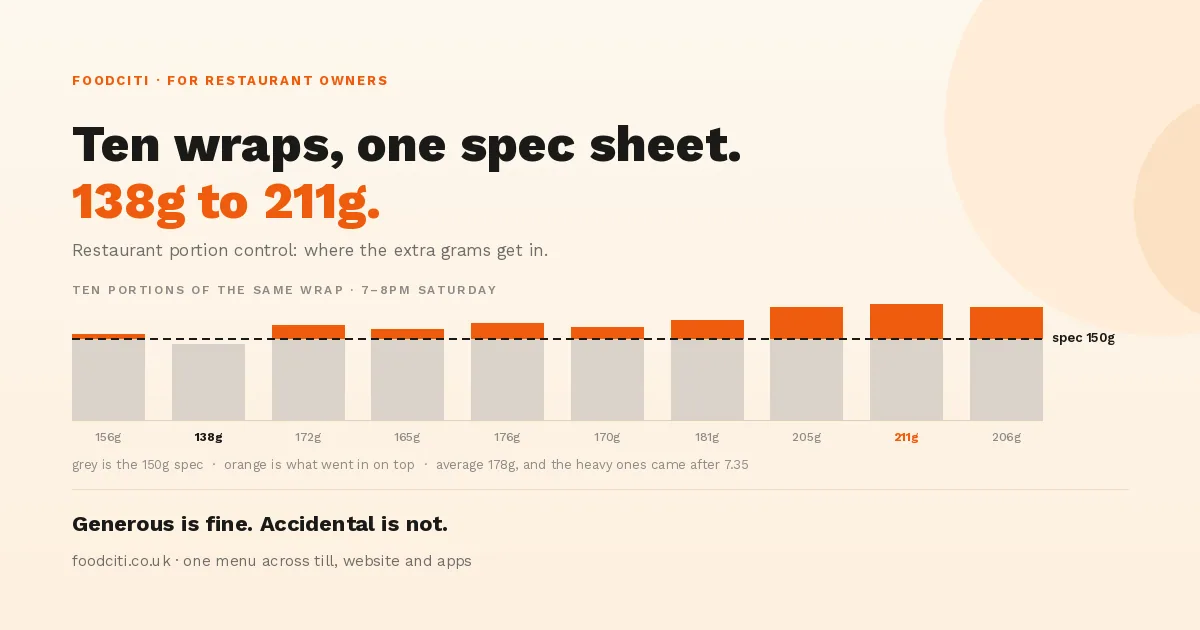
Put a small scale beside the board on a Saturday. Across the hour from seven to eight, weigh the chicken for ten wraps before it goes on the bread. Don't tell anyone what the number should be. People plate more carefully when a scale is watching, so whatever you find is the polite version.
The figures here are illustrative. Use your own dish.
The owner reckons this wrap takes 150 grams of chicken. Say the chicken works out at £8 a kilo once it is trimmed and marinated, so every gram is 0.8p and that portion is £1.20 of chicken.
The ten portions came in between 138 grams and 211 grams. Only one of them was within ten grams of 150. The four heaviest all went out after 7.35, when the queue was at its longest. Together the ten weighed 1,780 grams, an average of 178 grams: 28 grams more than the owner thinks goes in.
Twenty-eight grams is about 22p a wrap, which sounds like nothing. Sell 340 of them a week and it is £76 a week, or close to £4,000 a year, from one ingredient in one dish.
The lightest wrap carried £1.10 of chicken and the heaviest £1.69, at the same menu price, in the same box, in the same hour. And the 138-gram wrap is the one a regular notices, because they compare it with their last order, not with your spec. A second and third order rests on the food matching the last one, far more than on one generous night.
The box decides before the cook does
One step back is the container, and a box sets a portion more firmly than any instruction. Food that fills two-thirds of it looks mean, so it does not stay at two-thirds for long. Someone tops it up, the next person copies what a full box looked like, and within a month the box is the spec.
If a dish keeps coming in heavy, check the box before you talk to anyone about their hands. A smaller container, or one with an obvious fill line, fixes more than a conversation does.
The hand copies the last hand it watched
Most portioning is learned by watching. A new starter stands beside whoever has been there longest, sees roughly how much goes in, and does that. If the person they learned from runs generous, the whole kitchen runs generous within a few weeks.
Then the rush adds its own pull. At 7.40 there is no time to go back to the tray for two more pieces, so people take a bit extra first time. Nobody rings to complain about too much chicken. Plenty ring about too little. Every small incentive in the room points the same way.
The fix is not asking people to be careful. It is giving them a tool that makes careful effortless: a scoop that holds the portion when it is level, a skewer threaded to a weight rather than a length, one spoon kept for one sauce. The aim is a kitchen that never needs the scale during service.
Restaurant portion control belongs on the prep tray
The most reliable time to settle a portion is three in the afternoon, when nobody is in a hurry.
If the chicken sits in one big tray at the pass, every wrap is portioned by someone under pressure. If it is weighed out at prep, bagged, tubbed or threaded, the decision was made by someone with a scale and time, and service just picks up the next one.
Your prep sheet already decides how many portions to make, and there is a good case for scoring that forecast. It rarely says how much goes in each one. A weight beside the count is a small change to a sheet someone already fills in.
It will not suit every dish, so weigh first where a gram costs most. At £8 a kilo, a gram of chicken costs five times a gram of chips at £1.60 a kilo. Forty extra grams of chips is about 6p. Start with the protein.
The invoice moved and the dish didn't
The last step back is the delivery door, where the price per kilo changes without anyone in the kitchen touching it.
Say the wrap was priced when chicken was £7 a kilo, and 150 grams cost £1.05. Today the same 150 grams is £1.20, and the average portion from that Saturday hour carries about £1.42. Neither change was a decision. Both came out of the same margin.
Write it on one card and put it where the hands are
Restaurant portion control fits on one card per dish, kept at the pass at eye level rather than in a folder in the office. Start with your five best sellers.
The weight of every ingredient that costs real money, and the tool that delivers it. "150g, one level scoop" is a spec. "A good handful" is a habit.
The container, by name or size, so nobody reaches for the bigger box because the smaller ones ran out.
A photo of the dish built properly, taken from above on an ordinary day.
The cost per portion at today's invoice prices, and the date you worked it out. When the date is six months old, or a supplier's price letter arrives, cost it again.
The card also changes how people learn. A new starter is no longer copying the most generous person in the kitchen. They are copying the card.
Generous is fine. Accidental is not
None of this is an argument for being mean. Some places are known for their portions, and it brings people back.
If that is you, be generous on purpose. Spec the wrap at 180 grams, price it for 180 grams, and give it to everyone, not only whoever ordered at 7.40 when the queue happened to be long. A large option priced for the heavy portion is often the honest version of what the kitchen was already giving away.
The only difference between a generous kitchen and a leaky one is whether somebody wrote the number down.
What FoodCiti does about it
No till weighs the chicken. This is mostly a job for a scale, a card and ten minutes at the pass.
Software comes in at the multiplication. Reports & Dashboard shows what sold, by dish and by day, so the 340 a week in the sum above is your real number rather than a guess. If the weigh-in leads you to re-spec a dish or add a large option, your EPOS Till, Online Ordering page and Aggregator Listing run from one menu, so the change is made once.
Setup and training are on us and the first month is free, which is long enough to weigh four Saturdays and see whether the card held.