Most chefs can answer the first half of that question without thinking. The lamb went at twenty to nine. Everyone remembers, because running out is loud — the waiter comes back, the table has to be re-sold on something else, someone in the kitchen swears.
The second half is much harder. What went in the bin, or into the walk-in to be quietly used up on Sunday, or home with the kitchen porter? Nobody can name it, because nothing happens when there is too much. There is no moment. There is just a tray that goes back in the fridge.
That gap in memory is worth more than it looks. It is the reason the prep sheet creeps upward every year and nobody notices, and it is the reason the same dish runs out on the same night for months on end.
The prep sheet is a forecast
That is the thing worth naming plainly. When someone writes down twelve lamb shanks at four in the afternoon, they are making a prediction about what a few hundred strangers will feel like eating in five hours' time.
It is a real forecast, made under real uncertainty, and it decides a meaningful chunk of the night's money. And in most kitchens, nobody ever checks whether it was right. The sheet gets written, the sheet gets worked through, the sheet gets thrown away. A forecast nobody scores cannot improve. It can only calcify into habit and then drift.
Scoring it is not complicated. It takes about ninety seconds a night for four Fridays.
Take the five or six dishes that matter — your top sellers, plus anything expensive enough that waste hurts — and after service write two figures beside each one:
What you prepped.
What you actually sold.
That is the whole exercise. Four Fridays gives you twenty-odd data points and, more importantly, the shape of your own error: which dishes you consistently under-call, which ones you consistently over-call, and which ones genuinely swing week to week and always will.
Almost everyone is surprised by at least one dish. The one you thought was volatile turns out to sell within two portions of the same number every single Friday. The one you never think about is the one that has run out four weeks running.
The two mistakes do not cost the same
Here is where it gets interesting, and where most kitchens are quietly wrong.
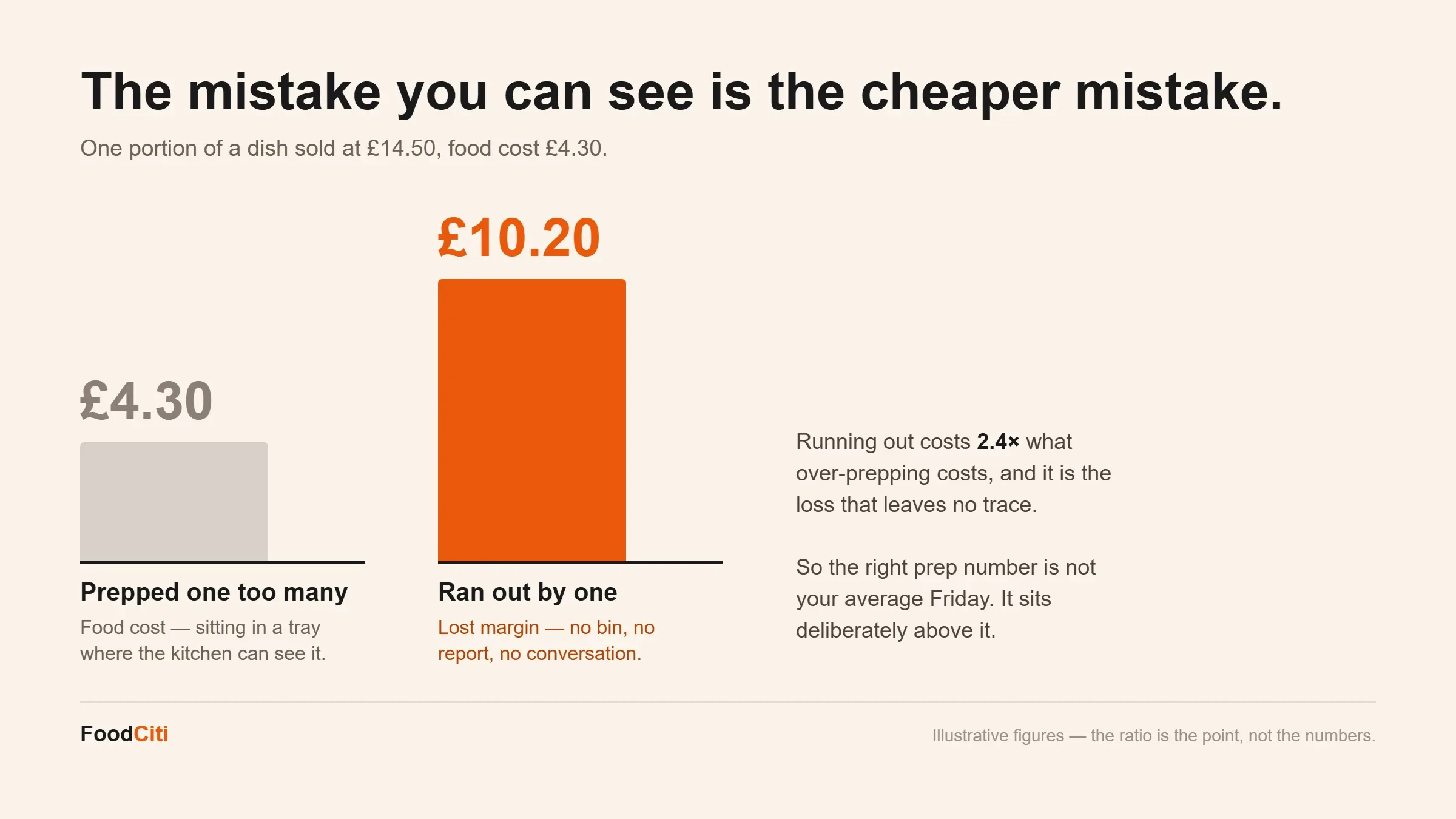
Take a dish on the menu at £14.50 with a food cost of about £4.30. Illustrative figures — use your own, the point is the ratio, not the numbers.
Prep one portion too many and it does not sell: you are out the £4.30 of food, and less than that if it holds over to tomorrow or feeds staff.
Prep one portion too few and someone wanted it: you are out the £10.20 of gross margin that portion would have made. Possibly more, if the table settles for something cheaper or orders somewhere else next time.
So running out costs about 2.4 times what over-prepping costs — and more than that every time the leftovers do get used. That is not a rounding difference. It changes what the right answer looks like.
Now put it back into the Friday you actually had. Twelve lamb shanks prepped, twelve sold, and five more people who asked after it was gone: 5 × £10.20 = £51 of margin that walked out. Ten sea bass prepped at a food cost of £4.90 each, four sold, six left over: 6 × £4.90 = £29.40 of food.
Look at which of those two numbers is visible. The £29.40 is sitting in a tray where the whole kitchen can see it, and it will get talked about. The £51 does not exist anywhere — no bin, no line on a report, no conversation. It is the bigger loss and it is the invisible one.
That inversion is the whole problem in one sentence. The mistake you can see is the cheaper mistake.
So the right number is not the average
If the two errors cost the same, you would prep for a typical Friday and be done. They do not cost the same, so you should not.
The number on the prep sheet should sit deliberately above your average — high enough that you cover most Fridays rather than the middle one. A rough way to land on it without any maths: line up your last five or six Fridays for that dish and prep for the second-highest, not the middle. You will have leftovers more often than you do now. You will run out much less often, and the arithmetic above says that trade is worth making.
Two honest caveats. It only works for things where leftovers genuinely hold — sauces, braises, marinated meat, prepped veg. For a dish where an unsold portion is a total write-off by eleven o'clock, the ratio narrows and you should aim lower. And running out late in service is a different event from running out at half seven; the first is close to harmless, the second reshapes the rest of the night.
The real fix is not a better guess
Guessing better has a ceiling, and most kitchens are already near it. The deeper problem is timing: the decision gets made at four o'clock, and the information that would have answered it arrives between seven and nine.
Which points at three things worth more than any amount of forecasting skill. The first is shortening the gap — finding the point in each prep job that can be left until service and finished to order, so the quantity decision moves later, closer to the evidence. Par-cook to the last step rather than the last two. The second is getting the evidence earlier: bookings for the evening, pre-orders, scheduled orders, the covers already on the sheet by five. Every one of those turns a guess into a count. The third is the boring one — writing down what happened, so that in eight weeks you are working from twenty Fridays of your own data instead of the memory of the last bad one.
None of that requires a system. A notebook by the pass does the job. But it does require the numbers to exist somewhere you can look at them, and for most kitchens the honest answer is that they do not.
Where FoodCiti fits
This is the part we can actually help with, and it is unglamorous.
Reports & Dashboard gives you what sold, by dish, by day and by hour — so a question like "how many lamb shanks on the last six Fridays" takes ten seconds rather than an evening with a stack of dockets. Table Management puts the evening's bookings, floor plan and waitlist in front of you before service starts, so the covers you already know about are a count rather than a feeling. Telephonic Orders and Online Ordering log every order as it lands, including the ones that come in during the rush and would otherwise never be written down anywhere.
One related point we have made elsewhere and will not re-argue here: where your order history lives determines whether you can ask questions of it at all. That is covered in our post on what a commission order really costs.
Start with the two columns and four Fridays. You do not need us for that, and it will tell you which dish to fix first.
See how it works for your restaurant → https://foodciti.co.uk/partner