Ask an independent how they plan to grow and the answer is nearly always about people who have never eaten your food. A leaflet drop. A launch offer. A listing somewhere new. More new customers.
It is not a bad instinct. It is just the expensive half of the job, and most kitchens do it while ignoring the cheap half sitting in their own order history.
Here is the sentence worth sitting with. The customers who will pay for your next twelve months have almost all eaten your food already. You just don't know which ones they are, because nobody ever counted.
Do this once. It takes about twenty minutes.
Pick a month far enough back that its story has finished — six months is about right — and get whatever record you have of who ordered. Then:
Count the people who ordered from you for the first time in that month. Not orders. People.
Of those, count how many ever ordered a second time.
Of those, how many ordered a third.
Of those, how many have ordered in the last eight weeks.
Four numbers. That is the entire exercise, and they will tell you more about next year than your revenue totals will.
What the four numbers tend to look like
Here is a worked example — illustrative, use your own — from a takeaway looking back at last March.
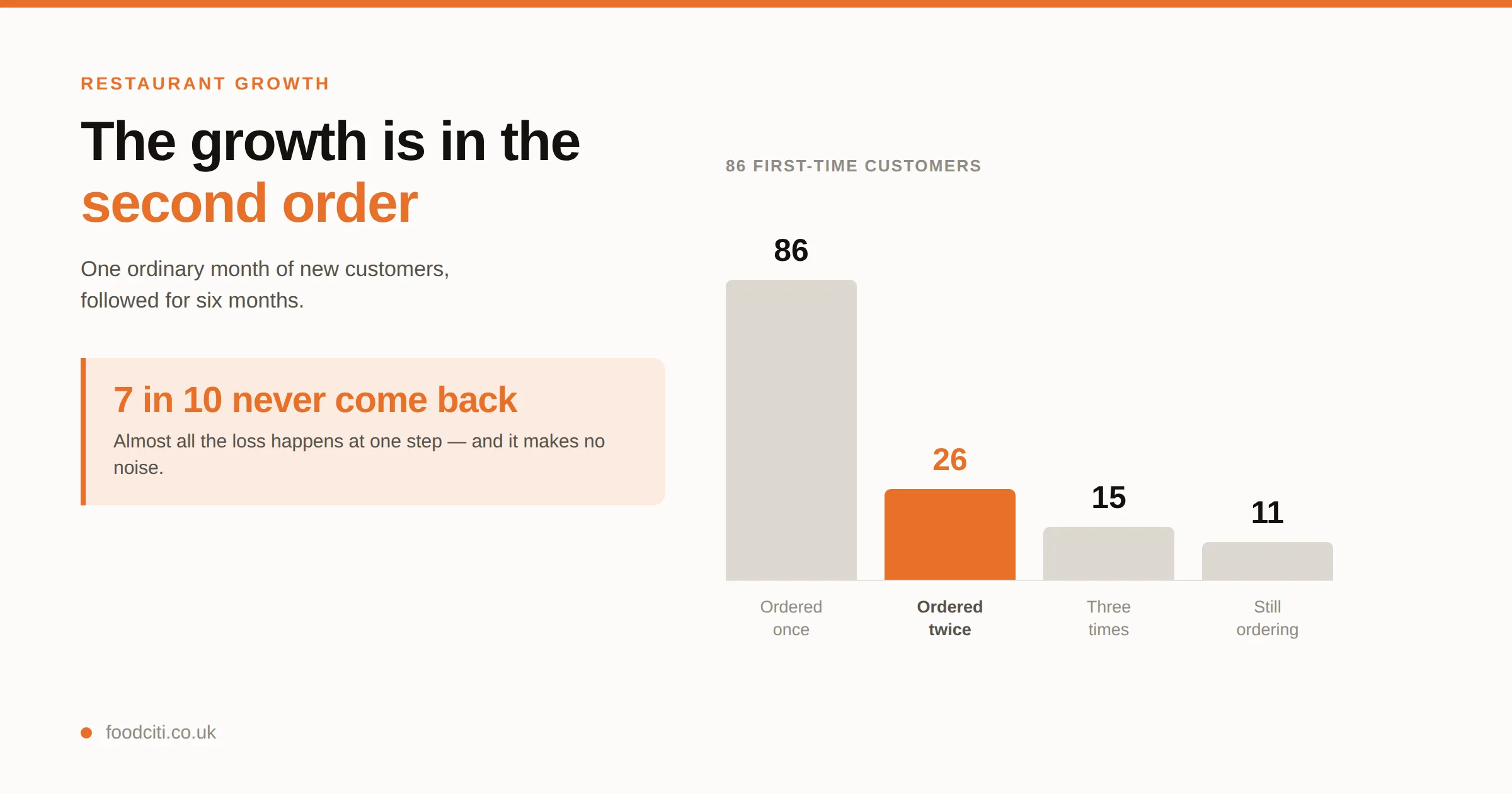
86 people ordered for the first time that month. 26 of them ordered a second time. Of those 26, 15 came back for a third. And 11 of the original 86 are still ordering today.
Read the shape rather than the figures. About three in ten survived the first order — and that is where nearly all the loss happened. Look at what comes after. Of the 26 who came back once, close to six in ten went on to a third. Eleven of them — more than four in ten of everyone who ordered twice — turned into regulars.
That is the finding in one line. The drop-off is almost entirely at the second order. Past that point the numbers stop falling off a cliff. People who have ordered three times mostly keep ordering until you give them a reason to stop.
So the second order is not one step in a funnel among several. It is the step.
What being slightly better at it is worth
Those 11 regulars, ordering monthly at £24, are £264 a month — a little over £3,100 a year, out of one ordinary month's worth of new faces.
Now change nothing about your food, your prices or your marketing, and get better only at the second order: 45% instead of 30%. That is 39 of the 86 coming back once instead of 26. If the same proportion of them go on to stick, you finish with roughly 16 regulars instead of 11.
Five more people. About £1,440 a year, from the same March, the same leaflets, the same everything.
Now do it the other way round. To reach those same five regulars through strangers, at the one-in-eight rate above, you would need something like 39 extra first-time customers — a second March, bolted on. The alternative is persuading 13 people who have already eaten your food and liked it to order once more.
One of those is a marketing budget. The other is a habit.
The window closes quietly, and nobody tells you
The reason the second order is so easy to lose is that losing it makes no noise. A first-timer who never returns doesn't complain, doesn't leave a review, doesn't ring up. They simply order from somewhere else in three weeks' time, and nothing in your kitchen registers it. Your Friday still looks busy. The total still looks fine. The hole is invisible because it is made of absences.
And the window is shorter than most operators assume. Someone who ate your food last Saturday remembers it now. In five weeks they remember that they ordered something from somewhere and it was fine. You are not competing with the restaurant down the road for that person. You are competing with them having forgotten you exist.
What actually earns it
Not much of this is clever, which is why it goes undone.
The first order has to be right — not excellent, right. Complete, hot, on time, and matching what they thought they were buying. A merely correct first order beats a spectacular one that arrived forty minutes late, because the second order is bought with confidence, not delight.
Then they have to be able to find you again without effort. Most people who intend to come back do it from wherever is nearest to hand: a saved link, a number in their phone, a bookmark, an app they already have open. If getting back to you means remembering your name and searching for it, a meaningful share of the people who meant to return simply won't.
Then, when they do come back, you have to act as though you know them. Not a loyalty scheme — recognition. The caller whose usual is already on screen. The order that doesn't need the postcode spelled out again. Small, and it is most of what "regular" actually feels like from the customer's side.
And you have to know who has gone quiet, which is the one part that genuinely requires a record rather than a good memory.
The discount is the most expensive way to do this
The instinct at this point is 20% off the next order. It is worth understanding what that buys.
A discount reliably produces an order. What it does not reliably produce is a habit, because it teaches the accurate lesson that your food is worth what the voucher says. The people most likely to take it are the ones who were coming back anyway — so you pay a margin you did not need to pay on your best customers, to look like you did something.
If you are going to spend, spend it on the parts above: getting the first order right, being easy to return to, and knowing a returning customer when you see one. Those compound. A discount is rented.
What FoodCiti does about it
Online Ordering gives you a branded page of your own, which is the thing people bookmark and come back to — and the orders that arrive through it carry no per-order commission. Telephonic Orders is the recognition part: caller ID pulls up the customer's order history as the phone rings, so a returning customer is treated like one without anybody having to remember them. Your Personal Website and Aggregator Listing are how the first-timers find you in the first place; the point is that they land somewhere you own.
And Reports & Dashboard is where those four numbers come from, so the twenty-minute exercise above becomes something you can check rather than reconstruct.
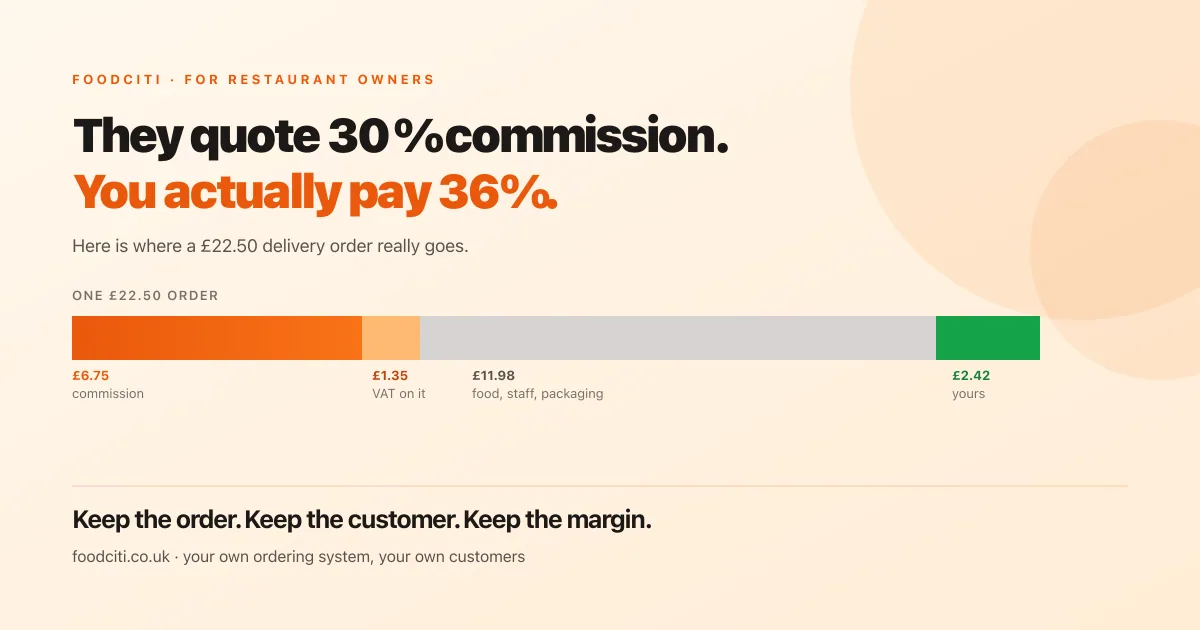
One more thing worth saying plainly: you can only do any of this for customers you can actually see. If a third party holds the relationship, the returning-customer work is not available to you at any price — we went through what that costs in our post on what a £22.50 order really pays.
Go and get the four numbers. Then work on the second one.