Every kitchen has one hour that decides how the whole night feels. In a lot of independents the restaurant peak hour starts at around ten to seven and it is properly over by twenty past eight, and the middle of it — 19:00 to 20:00 — usually carries more of the evening's orders than any other hour of the week. Your own hour-by-hour totals will tell you whether that is true of yours.
Ask anyone who works that hour what the plan is, and the answer is always some version of the same thing: go faster.
So everyone goes faster. Nobody stops. And the hour still runs late, still burns two or three orders, still ends with somebody apologising on the phone. Next Friday, the plan is to go faster again.
Going faster is not a plan. It is what you do when you don't know where the jam is.
In the restaurant peak hour, one thing is full before everything else
On a Tuesday, everything in the building has slack. Orders arrive one at a time and every station finishes before the next one lands. Nothing is a bottleneck, because nothing is full.
Peak is a different animal. At peak, one thing in your operation usually saturates before everything else does, and from that moment it sets the pace of the entire hour. Not the kitchen. Not "the team". One thing.
Which has an uncomfortable consequence. Any improvement you make to something that is not the constraint changes almost nothing you can feel on a Friday. A faster fryer doesn't help if tickets are stacking at the pass. A second pair of hands at the pass doesn't help if the orders can't get into the system fast enough to reach it. You can work hard all week on the wrong thing and Friday will look exactly the same.
So the first job isn't speed. It is finding out which thing is full.
Four candidates, and how to tell which one is yours
You can run this on a single Friday. You need a pen and somebody who isn't cooking.
1. Intake — the orders can't get in. The tell: calls ringing out between 19:00 and 20:00, and a tablet with orders sitting unaccepted for minutes. If a person is standing still holding a phone while food waits, intake is your constraint. Count the missed calls. That is your number.
2. The pass — food is ready before it can leave. The tell: plates or bags sitting under the lamp while somebody re-reads a ticket, finds the sauce, hunts for a bag. Time one order from ready to gone at 19:30, then time the same thing on a quiet Tuesday. The difference between the two is the pass.
3. One station — everything queues behind one piece of equipment. The tell: order times that are fine unless the ticket has a particular item on it. Grill, fryer, tandoor, pizza oven. Pull twenty tickets from the hour and mark the late ones. If the late ones share an item, you have found it.
4. The handover — the food is finished and waiting. The tell: bags going cold on the shelf with no driver, or three collection customers in a doorway built for one. Time from bagged to out the door. If that runs longer than the food stays hot, you are ruining it after you finished cooking it.
It is easy to be certain you know the answer before you measure. Measure anyway, on one Friday. The answer is often not the station everyone complains about.
Why speed is the weakest lever you own
Here is the part that changes how the hour looks.
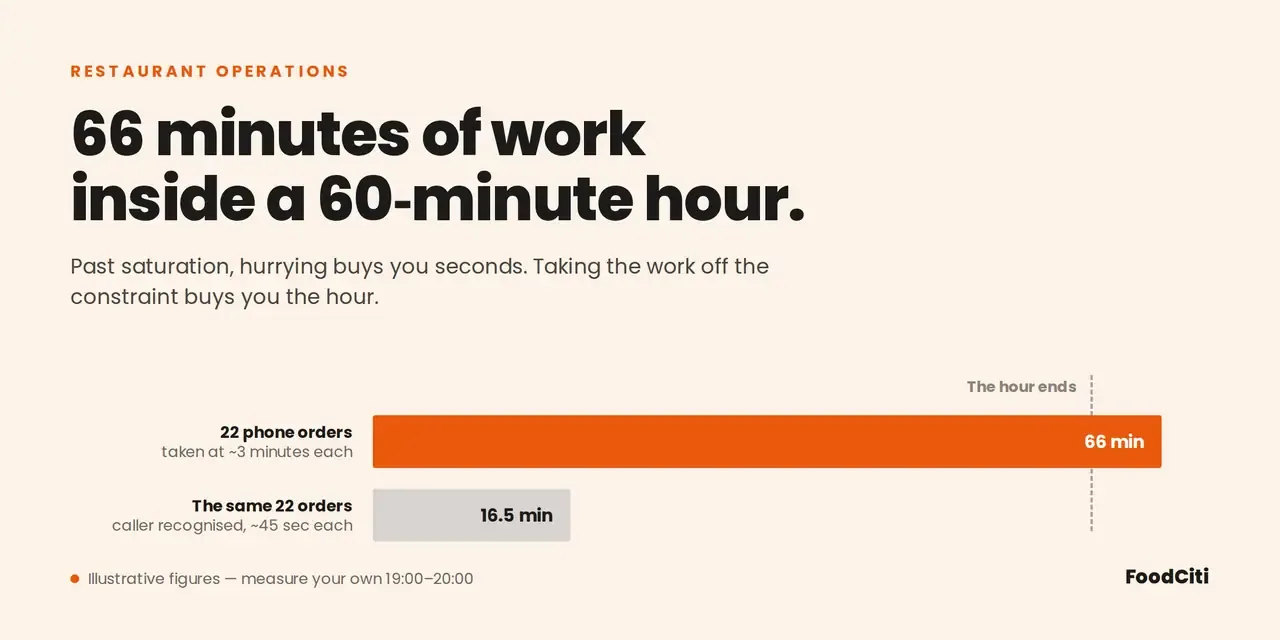
Say Friday brings 66 orders between 19:00 and 20:00, and a third of them — 22 — come in by phone. At around three minutes a call, taking those orders is 66 minutes of work inside a 60-minute hour. (Illustrative figures. Use your own.)
Read that again. It isn't slow. It is impossible. There is more work than there is hour, and no amount of hurrying closes a gap like that, because the gap isn't in anyone's effort — it is in the arithmetic. Every order past the point of saturation joins a queue, and that queue grows by every order that arrives faster than you can clear one.
Now weigh two fixes against each other.
Shave five seconds off every call by being brisk: 22 calls, 110 seconds. You save under two minutes across the whole hour, and you sound rushed to 22 customers.
Take those same 22 orders in 45 seconds each instead of three minutes — because the caller is recognised, their last order is already on screen, and nobody is spelling a postcode: that is 16.5 minutes instead of 66. You have handed back the better part of an hour to the same people, on the same night, and nobody moved any faster.
That is the asymmetry, and it is worth writing on the wall. Inside the constraint, effort buys you seconds. Taking work off the constraint buys you the hour.
The three moves you have left at 19:40
You cannot add capacity mid-service. Nobody new arrives, nothing gets installed, the oven does not get bigger. So there are only three things you can do to an hour once it has started, and going faster is not one of them.
You can move work earlier. Anything that doesn't have to happen inside the hour shouldn't be in it: prep, bags and boxes stocked at the pass, sauces decanted, drinks fridge filled, card machine tested, printer paper changed, and the delivery area and quoted times you are actually working to tonight rather than the ones set last March. The hour is won between 18:00 and 19:00, by people who aren't busy yet. How much to prep is a different question with a different answer — we worked through that one separately; this is only about what has no business still being unfinished at 19:40.
You can move work later, on purpose. A quoted time of 55 minutes that you hit is a better night than a quoted 30 that you miss, and stretching the quote during peak is how you stop the queue compounding — not an admission of defeat. The failure isn't the long quote. It is quoting 30 because that is what it has always said.
Or you can refuse work, honestly. Pausing new orders for fifteen minutes, or closing the far edge of your delivery area while the pass is drowning, costs you a handful of orders tonight. Taking all of them and serving them badly risks the customers who don't come back, and the review that gets written at 23:04.
None of the three feels good in the moment. All three beat going faster.
What FoodCiti does about it
Most of the work above is operational and no software performs it for you. Some of it is ours to make easier.
Telephonic Orders brings up caller ID with the customer's order history when the phone rings — that is where the difference between roughly three minutes and roughly 45 seconds comes from. Online Ordering takes the intake job off a human entirely on your busiest night, on your own branded page. The EPOS Till and Mobile POS keep the ticket moving, and they work offline, so the hour doesn't stop when the broadband does. Table Management handles the front-of-house version of the same jam. And Reports & Dashboard is where last Friday's hour is recorded rather than remembered — which matters, because next Friday's plan should be built on the first one.
Efes Kebab measure the result in hours: six a week, back.
Find your constraint first. Then take the work off it.