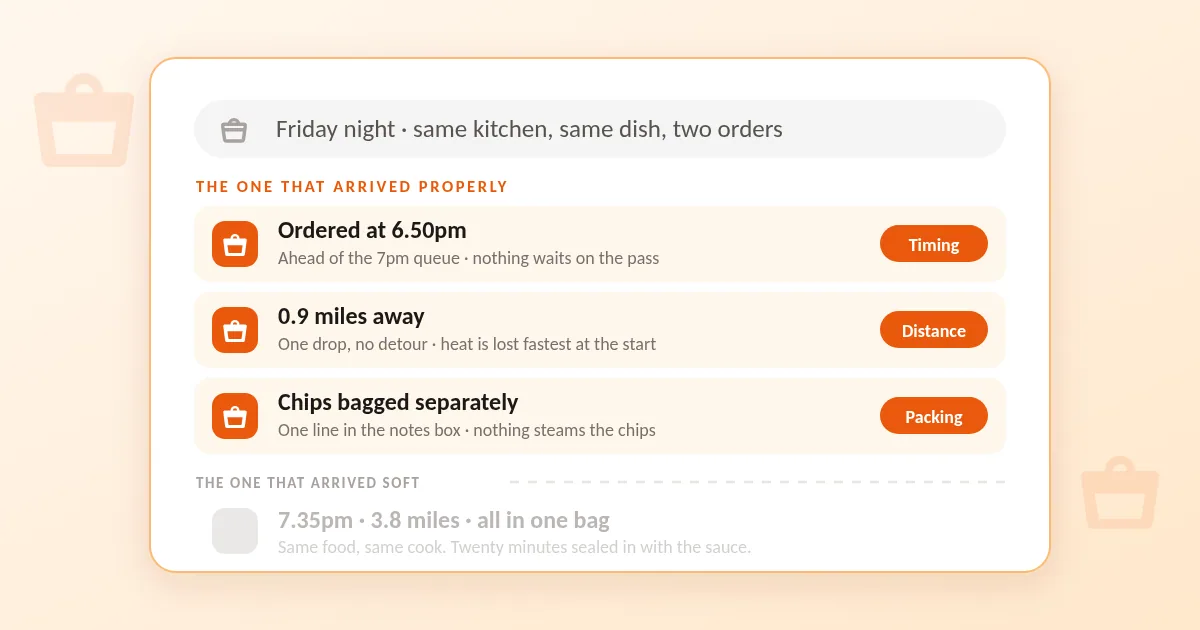
Friday night. A kebab house in town sends out two identical orders: chicken shish, chips, a pot of sauce. Same cook, same fryer, same twenty minutes of the evening.
One of them is eaten hot, with the chips still crisp. The other arrives warm at best, and the chips have gone soft in the bag.
Nothing in the kitchen was different. Everything that separated those two dinners happened outside it — and most of it was decided by the person ordering, before they tapped anything.
Here is where the two orders came apart.
They ordered at different times
The first order goes in at 6.50pm. The second at 7.35pm.
That three-quarters of an hour is the difference between a kitchen with space and a kitchen at full stretch. In the first case the food is cooked, bagged and collected more or less continuously. In the second, the ticket joins a queue, and when the food is ready it waits — on the pass, in the open air — for a driver who is already carrying somebody else's dinner.
That wait is the expensive one, because hot food loses heat fastest at the very start, when the gap between the food and the air around it is at its widest. Ten minutes on the pass costs you far more than ten minutes in a closed bag in a car.
You can see this coming before you order. Look at the quoted time on the restaurant's page at 6.45 and again at 7.30. If it has stretched from 25 minutes to 55, that is not a glitch — that is the kitchen being honest with you about the queue. Restaurants that let that number move are doing you a favour. (Owners: we wrote about the 7pm hour from your side.)
They ordered from different distances
The first was 0.9 miles away. The second, 3.8.
The extra time matters less than what the extra distance changes. A short hop is usually a single drop. A longer run is more likely to be paired with another delivery, more likely to involve a route, and more likely to mean your bag was picked up while the previous one was still being delivered.
The map on the ordering page tells you this before the estimate does. On a Friday, the difference between a kitchen down the road and one on the other side of town is not four minutes. It is a different kind of journey.
One of them asked for the chips to be bagged separately
Some food survives a bag and some food fights it.
Anything wet and heavy holds heat well: curries, stews, dal, rice, biryani, a meat kebab, noodles in broth. Anything fried and crisp is on a timer from the moment the lid goes on, because hot food gives off steam, and steam trapped in a sealed container condenses on the lid and rains back down on your chips.
That is the part people misdiagnose. Often the complaint is not really heat at all — it is texture. A lukewarm curry is still a perfectly good curry. Lukewarm chips are a different, sadder food.
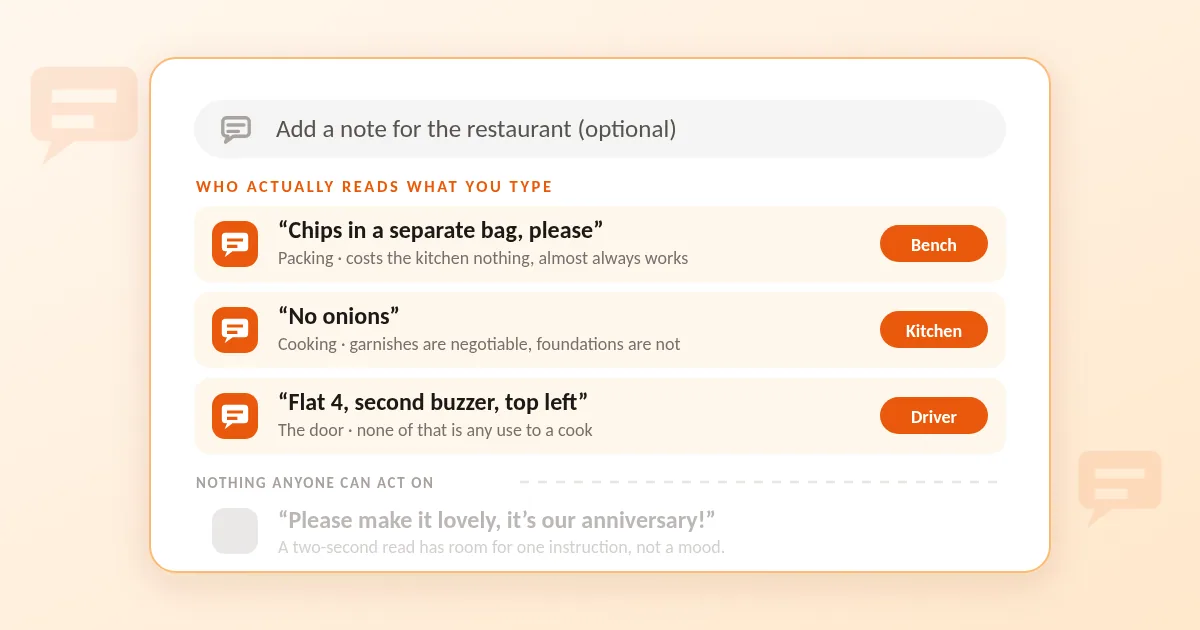
The first order asked, in the notes box, for the chips to be bagged separately from the sauce. One line. It costs the kitchen nothing and it is the single cheapest thing on this list. The second order didn't ask, so the chips travelled pressed against a hot sauce container in a sealed bag, steaming themselves for twenty minutes.
They spent their last two minutes differently
The first diner watched the tracker and opened the door as the driver reached it.
The second was upstairs and heard the buzzer late. Two minutes standing in a communal hallway — cold air, no insulation, bag half open while somebody finds a key — undoes a surprising share of what the driver protected on the way over.
If you are within about ten minutes of the restaurant, collection skips almost all of this. The food has never sat in a bag waiting for anyone, and it is the version the kitchen intended.
What you cannot see, and should not blame yourself for
Being honest about the limits of all this: some of what ruins a delivery is invisible from outside.
If a kitchen bags your order fifteen minutes before a driver is free, nothing you did caused that and nothing you choose next time will fix it. The only clue you get from the outside is a quoted time that keeps climbing while you wait. If a place is regularly 30 minutes late on a Friday and the estimate never moves, that is worth knowing about them. If the estimate moves honestly, that is worth knowing too — in the other direction.
And none of this makes an ordinary meal a good one. It just means you get to taste what the kitchen actually sent.
Where FoodCiti fits
We cannot change the physics of a paper bag. What we can do is give you the things that decide the outcome above.
Real-time tracking, so you are at the door rather than behind it. Local independents, which in practice means shorter routes than a city-wide list. Collection on the same menu as delivery, for the nights you are round the corner anyway. And a notes box on every order, which is where "chips bagged separately, please" goes.
Free delivery over £15, and if you would rather not scroll a menu at all, ORVO lets you say the order out loud and builds it for you.
Two orders, one kitchen, one good dinner. The difference was about ninety seconds of thought before tapping.