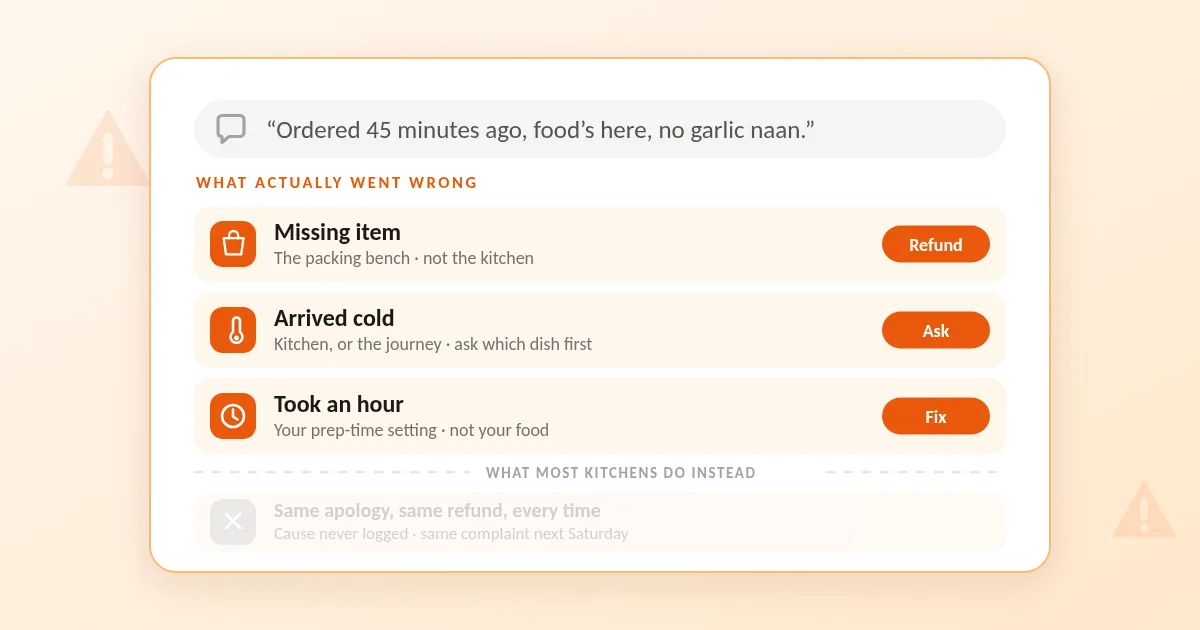
At 8:15 on a Saturday the message lands: "Ordered 45 minutes ago, food's here, no garlic naan."
You are three tickets deep. The easy move is to refund the naan, type "so sorry for the inconvenience", and get back to the pass. That works, in the sense that nothing catches fire. But the naan cost you £3.20, and the person who ordered from you most Fridays for the last eight months is, at that exact moment, deciding whether you are a place that had a bad night or a place that gets it wrong. The refund is the cheap part of this.
The reason most complaints get handled badly is not that owners don't care. It's that every complaint gets the same response — apologise, refund, move on — when the four things that actually go wrong are four different problems with four different owners.
Sort it before you solve it
Almost every "the order was wrong" message is one of four failures. They arrive in the same tone and they feel the same at 8:15 on a Saturday, but they happen in different places in your operation and the correct response is different for each.
What the customer says | Where it actually went wrong | The response that works | The fix that stops it recurring |
|---|---|---|---|
"You forgot the naan" | The packing bench, not the kitchen | Refund the item straight away. No questions, no negotiation. | One person reads the ticket against the bag before it's sealed. Out loud. |
"It was cold / soggy / not what I ordered" | The kitchen, or the journey | Ask one question — which dish, how long did it take — then decide | Look at whether that dish travels. Vent the lid on fried items or bag them separately. |
"It took an hour" | Your prep-time setting, not your food | Acknowledge the real reason. Don't hide behind "we were busy." | Set prep times for a Saturday, not for a Tuesday. |
"It never arrived" | The address, the handover, or the door | Find out where it went before you refund | Make sure the driver can see delivery notes and a phone number. |
Two of those four are packing and settings — nothing to do with your food, and both cheap to fix. Kitchens tend to assume complaints are a verdict on the cooking. Usually they aren't.
Refund, replace, or neither
A rule of thumb worth writing down and giving to whoever is on the phone:
Missing or clearly wrong item — refund it immediately, without asking anything. The item is small, the customer is right, and every second you spend establishing that costs more than the item. Arguing over a £3 side is the single most expensive habit in this trade.
Quality complaint — one question, then decide. "Which dish was it, and roughly how long did it take to reach you?" That question is not an interrogation, it's diagnosis: the answer tells you whether it's a kitchen problem or a travel problem, and you need to know that for next week. Most people who complain are telling the truth and will answer it happily.
The whole order is wrong — replace it if they'll wait, refund if they won't. Ask them which they'd prefer rather than deciding for them. A remade order that arrives in twenty minutes rescues the relationship far better than money back.
And the rare one who complains every single time — you are allowed to notice. Keep a record, be polite, stop refunding. A very small number of people work out which places fold fastest. You are not obliged to be one of them.
What you actually write back
The reply matters more than the refund, and it takes thirty seconds. Three ingredients:
Name the specific thing that went wrong. Not "any inconvenience" — the naan.
Say what happened, briefly, without excuses.
Say what you've done about it.
Hi Sam — you're right, the garlic naan wasn't in the bag. That's our packing bench, not the kitchen, and I've refunded it now. Next order this week, the naan's on us. Sorry about tonight. — Raj
That's it. It works because it's specific, it's signed by a person, and it admits the thing rather than performing regret at it. "We value your feedback and will pass this to the relevant team" does the opposite: it tells the reader they are talking to a process.
One more thing about the reply — speed beats generosity. A £3 refund in four minutes buys more goodwill than a full refund the next afternoon.
When they go to their bank instead of to you
Occasionally a diner skips the complaint entirely and disputes the payment with their card provider. That's a chargeback, and it's a different animal: you're no longer having a conversation, you're submitting evidence.
What decides these is records, not arguments. A timestamped order, proof it was handed over, and the message thread showing you responded. If you have those, you have a case. If your only record is a memory of a busy Saturday, you don't — and the fee for losing usually stings more than the order was worth.
The more useful point: most chargebacks are complaints that nobody answered. People go to their bank when they feel ignored. Answering within the hour is a cheaper defence than winning a dispute.
The one number worth counting
Not tonight — at the end of the month. Take last month's complaints, drop each one into the four buckets above, and divide by how many hundred orders you did. You now have a complaint rate, split by cause.
The point isn't the total. It's which bucket is fattest. If it's packing, you have a five-minute fix and a genuinely good month ahead. If it's timing, you have a settings problem. If it's the food, that's harder — but at least you know, instead of assuming, and you'll know which dishes.
Most owners have never done this and are surprised by the answer. The complaint that stings the most is rarely the one that happens the most.
What FoodCiti does about it
Not everything here is a software problem — no system puts the naan in the bag. What a system can do is make sure you're never reconstructing what happened from memory.
On FoodCiti the order sits in your own dashboard with its timeline: when it was placed, accepted, and handed over. Prep times and delivery radius are your settings to tune, not someone else's defaults. And because the customer relationship is yours, you can go back to the person directly and make it right, rather than filing a ticket with a middleman and hoping.
That's what turns a bad Saturday into a customer who orders again on Friday.
See how it works for your restaurant → https://foodciti.co.uk/partner