Somebody within a mile of your kitchen picked up their phone forty minutes ago and typed "curry near me". Or "best pizza Canterbury". Or "chinese open now".
They ordered from someone. It probably wasn't you.
Not because your food is worse. Because the decision was made in about ninety seconds, on a screen, before your name ever came up. That is the whole game now, and most independents are not playing it — not because it is hard, but because nobody ever told them what actually matters.
Here is what actually matters.
Start with how the search really works
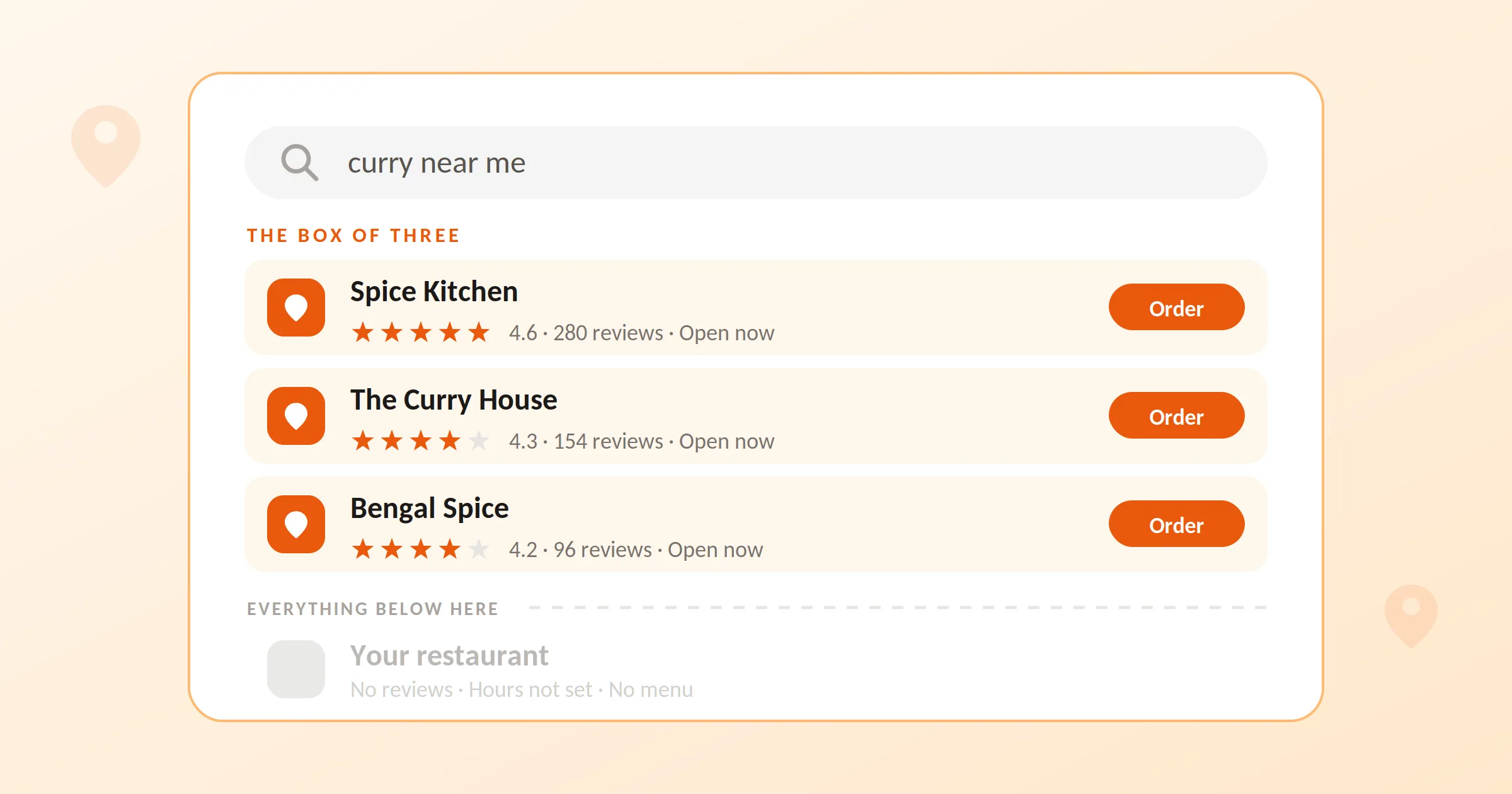
When someone searches for food nearby, they almost never scroll to a list of websites. They see a map with three restaurants pinned on it, star ratings underneath, and an ordering button.
That box of three is the shop front. Everything below it is the car park.
What decides who lands in it comes down to three things Google weighs: how close you are to the person searching, how relevant your listing looks to what they typed, and how established your business appears — reviews, activity, consistency across the web.
You cannot change the first one. You have a surprising amount of control over the other two, and almost nobody uses it.
Your Google Business Profile is doing more work than your website
If you fix one thing this month, fix this.
Your Google Business Profile is the free listing that produces the map pin, the star rating, the photos, the opening hours and the "Order online" button. For most takeaways it gets more views than the website does — by a wide margin. And most profiles are half-finished: hours that were right in 2023, a category set to "Restaurant" when you are a fish and chip shop, four photos taken on a Nokia, no menu.
Every empty field is a reason for Google to show someone else.
The fixes are unglamorous and they work:
What to fix | Why it matters | How long |
|---|---|---|
Primary category (be specific — "Fish and chips takeaway", not "Restaurant") | It is the single strongest relevance signal on your profile | 2 minutes |
Opening hours, including bank holidays | Wrong hours produce one-star reviews from people who turned up to a dark shop | 10 minutes |
15–20 real photos: the food, the front, the inside | Profiles with real photos get clicked far more than ones without | 30 minutes |
Your full menu with prices | Feeds "near me" searches for individual dishes | 45 minutes |
A direct ordering link to your own site | Sends the click to a channel you own instead of a commission channel | 5 minutes |
A short post every couple of weeks | Signals the business is alive and trading | 10 min / fortnight |
Total: an afternoon, once, then ten minutes a fortnight. There is no advertising budget attached to any of it.
Reviews are the bit everyone knows and nobody does
Two shops, same street, same food. One has 34 reviews at 4.1. The other has 280 at 4.6. The second one takes the order, every time, and it is not close.
The uncomfortable truth is that review counts are mostly a function of asking. Happy customers do not think to leave one. Annoyed customers always do. Left alone, your rating drifts toward the complaints.
So ask, at the moment the food was good — a card in the bag with a QR code, a line at the bottom of the order confirmation, the driver mentioning it. And reply to every review, including the bad ones. A calm, specific reply to a one-star does more for the next reader than the complaint does against you.
The newer thing: getting quoted, not just ranked
A growing share of "where should we eat" now happens inside an AI assistant. Someone asks for the best late-night kebab in Canterbury and gets a written answer with three names in it.
Those answers are assembled from text a machine can read — your listing, your reviews, directory entries, your website's actual words. Which creates a specific problem for restaurants: a beautiful site where the menu is a photo of a laminated sheet, or a page that only draws itself after JavaScript runs, is invisible to that process. The machine sees an empty room.
The fix is the same in every case: your name, address, phone number and menu should exist as real text, spelled identically everywhere they appear. Boring. Decisive.
What this is worth
No advertising spend, no agency. An afternoon of admin, a card in the bag, ten minutes a fortnight.
The return is that when someone three streets away decides they want what you cook, you are one of the three names they see — instead of the fourth, which is the same as not existing.
Work out your own number
Open your phone. Search the thing your customers would search — your food, your town, "near me". Do not sign in.
Where are you? First three? Second page? Not there?
Then check your own profile: are the hours right, is the category specific, when was the last photo added, how many reviews, and where does the ordering button send people?
Whatever you find, it is a list of fixable things. That is the good news about local search — it rewards the diligent, not the wealthy.
What FoodCiti does about it
Two parts of this we handle directly.
You get your own branded ordering website — real, indexable pages with your menu as text, so the ordering link on your Google profile sends customers somewhere you own rather than somewhere that takes a cut. And you get a listing on the FoodCiti marketplace, where local diners in Kent find independents like you.
Underneath both sits one unified menu. Change a price once and it updates on your site, your till, your marketplace listing and your phone orders — so the details that local search rewards stay consistent without anyone maintaining four versions of the truth.
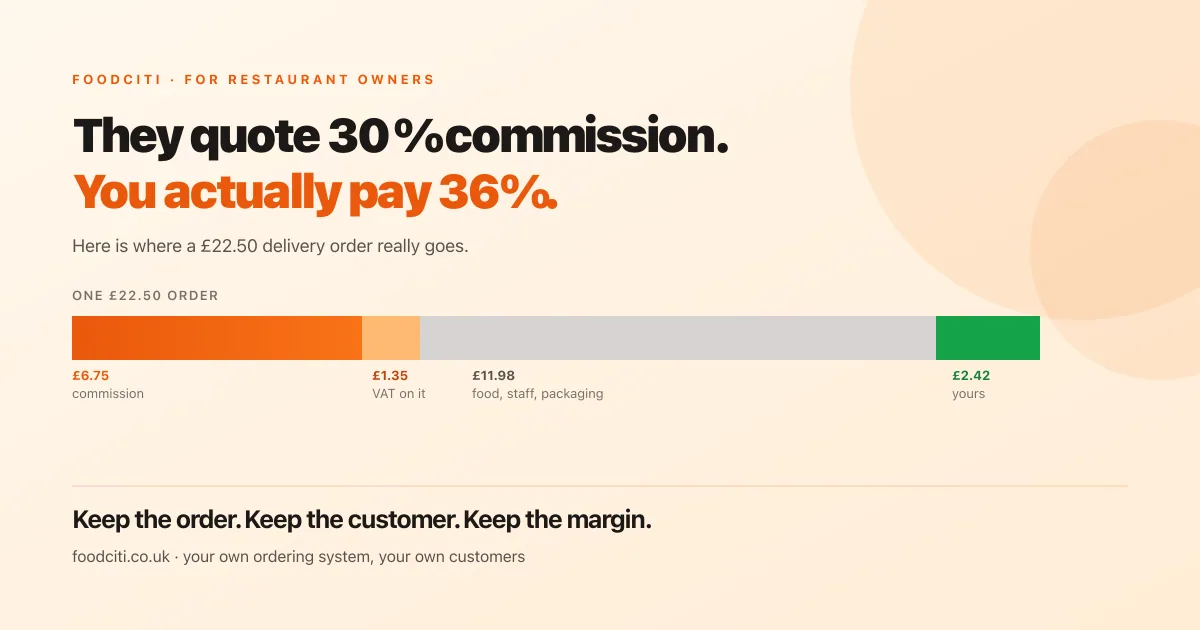
Flat monthly fee, 0% commission, from £39 a month. Free setup including menu import and staff training, live in 48 hours, cancel any time.