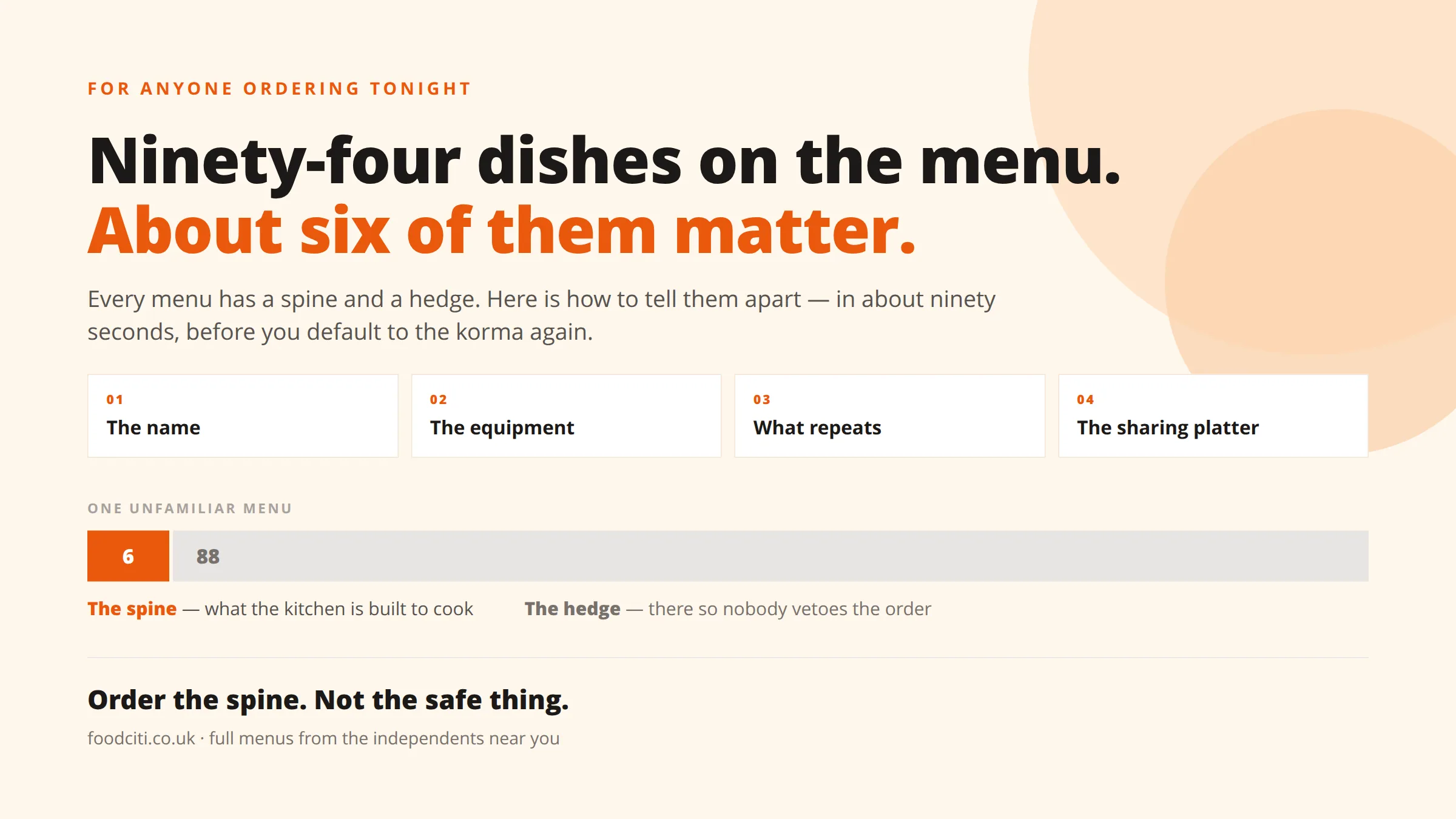
There are ninety-four dishes on the menu and you recognise eleven of them.
This is the moment most of us quietly give up. You scroll until something familiar appears — the korma, the sweet and sour chicken, the plain doner — and you order that. It arrives, it is fine, and you decide the place is fine. Then you go back to ordering from the same three restaurants you have used for two years.
Nothing went wrong there, exactly. But you ordered the dish that was put on the menu for people who are nervous, and then judged an entire kitchen on it.
There is a better way to read an unfamiliar menu. It takes about ninety seconds and it works on almost any of them.
Every menu has a spine and a hedge
The spine is what the kitchen is built to cook. It is the reason the equipment in the back is the equipment it is, the reason the person cooking learned to cook in the first place, and usually the reason the place is still open on a high street where most things are not.
The hedge is everything else. The lasagne in a kebab shop. The burger in a fish bar. The plain cheese pizza on a menu otherwise full of things with six toppings.
None of it is there by accident. It is there so that the one person in your group who will not eat anything unfamiliar does not veto the whole order — which is a completely reasonable thing for a restaurant to do. Hedge dishes get cooked competently and without much interest, and that is not a criticism of anybody. It is simply what happens to the fortieth item on a list when the first six are what people come for.
You want the spine. It is usually cheaper than you expect, and it is the version of the food the cook would eat.
Four things on the page that tell you which is which
The name. Central Fish Bar is telling you something. So is Royal Charcoal Grill. So is any name with a family or a town in it. A restaurant named after one thing has usually staked itself on that thing, and everything else on the menu arrived later.
The equipment you can infer. A tandoor, a charcoal grill, a wok burner set into the range, a wood oven, a serious fryer — these are expensive, they take up room, and they decide what a kitchen is good at. If the name or the photos tell you there is a fire in the back, order something that has been over it. Ordering the pasta instead is like going to a bakery for crisps.
Whatever repeats. Scan for the ingredient or the technique that keeps coming back. If lamb appears six different ways — shish, chops, ribs, kofte, in a wrap, on the mixed grill — the kitchen is telling you what it does all night, every night. Repetition on a menu is not padding. It is the specialism showing through.
The sharing platter. The most underrated line on any menu. A mixed grill, a thali, a banquet for four, a meze selection: somebody who actually works there sat down, decided what best represents the place, and wrote it out. It is the owner's own answer to what should we order? — and almost nobody reads it that way.
What this looks like in practice
Say there is a Turkish grill house two streets away and you have never ordered from it.
The name has charcoal in it, so there is a fire. Nine dishes go over that fire and they are grouped together near the top. Lamb turns up six different ways. And there is a mixed grill built for four people, which is the owner telling you precisely which of those things to eat.
So: order the mixed grill, add the one dish nobody at the table can pronounce, and let whoever needs something safe have a chicken wrap. You will spend roughly what you were going to spend anyway, and you will have eaten the actual food rather than the polite version of it.
The same reading works on a Sichuan menu, a Keralan one, a Lebanese one, a proper chippy. The signals do not change with the cuisine.
The part nobody says out loud
Sometimes you will get this wrong.
You will order the unpronounceable thing and it will turn out to be offal, or mostly bones, or far hotter than you wanted. That is the cost, and it is a small one: a single dish out of four, on one evening.
What you get back is a restaurant you now know how to order from. And there are probably a dozen within two miles of you that are very good at one specific thing and have never had the chance to prove it to you.
The safest possible order is also the least informative one. If you always order the korma, then every restaurant that sells korma is the same restaurant.
If you are ordering for a table
One anchor from the spine. One thing nobody recognises. One safe dish for whoever needs it. Then stop adding.
Four dishes chosen from the part of the menu the kitchen cares about will beat seven chosen defensively from across the whole thing. Check the prices while you are there, too — the hedge dishes are often not the cheap ones, because they are the ones the kitchen has to buy separate ingredients for.
Related, from the other side of the counter: Nobody reads your menu. They scan the first four things and pick one.
Where FoodCiti fits
Most of what we list is independents: grill houses, fish bars, curry kitchens and pizzerias that are locally famous for one particular thing and never quite got round to explaining it online.
Browse by cuisine and by neighbourhood, so trying somewhere new means somewhere close rather than somewhere across town
Full menus as the kitchen wrote them, so the signals above are actually there to read
Collection or delivery from the same menu, with free delivery on orders over £15
ORVO, if you would rather just say the order out loud — genuinely useful when you are ordering something you cannot spell
Ninety-four dishes is not a problem to be solved. It is a menu with about six things on it that matter, and you can now find them from the sofa in a minute and a half.