Walk into a takeaway and the sticker is usually by the door: green and black, a number from 0 to 5. Order on your phone and there is no door. You choose by photo, price and a star rating written by other diners, and the one assessment made by someone whose job is to inspect the kitchen never comes up.
In England, restaurants don't have to display their food hygiene rating at all, in the window or online. (Wales and Northern Ireland require it at the entrance, and in Wales takeaway menus must point you to the ratings website.) So if you want it, you have to go and get it. That takes about ninety seconds, and what you find is far more useful than the number.
Here is what to read, in the order it appears.
The number is a fair summary, and nothing more
Ratings run from 5, "very good", down to 0, "urgent improvement necessary". The one people misread most is the 3. It sounds middling, but the official wording is "generally satisfactory": a pass.
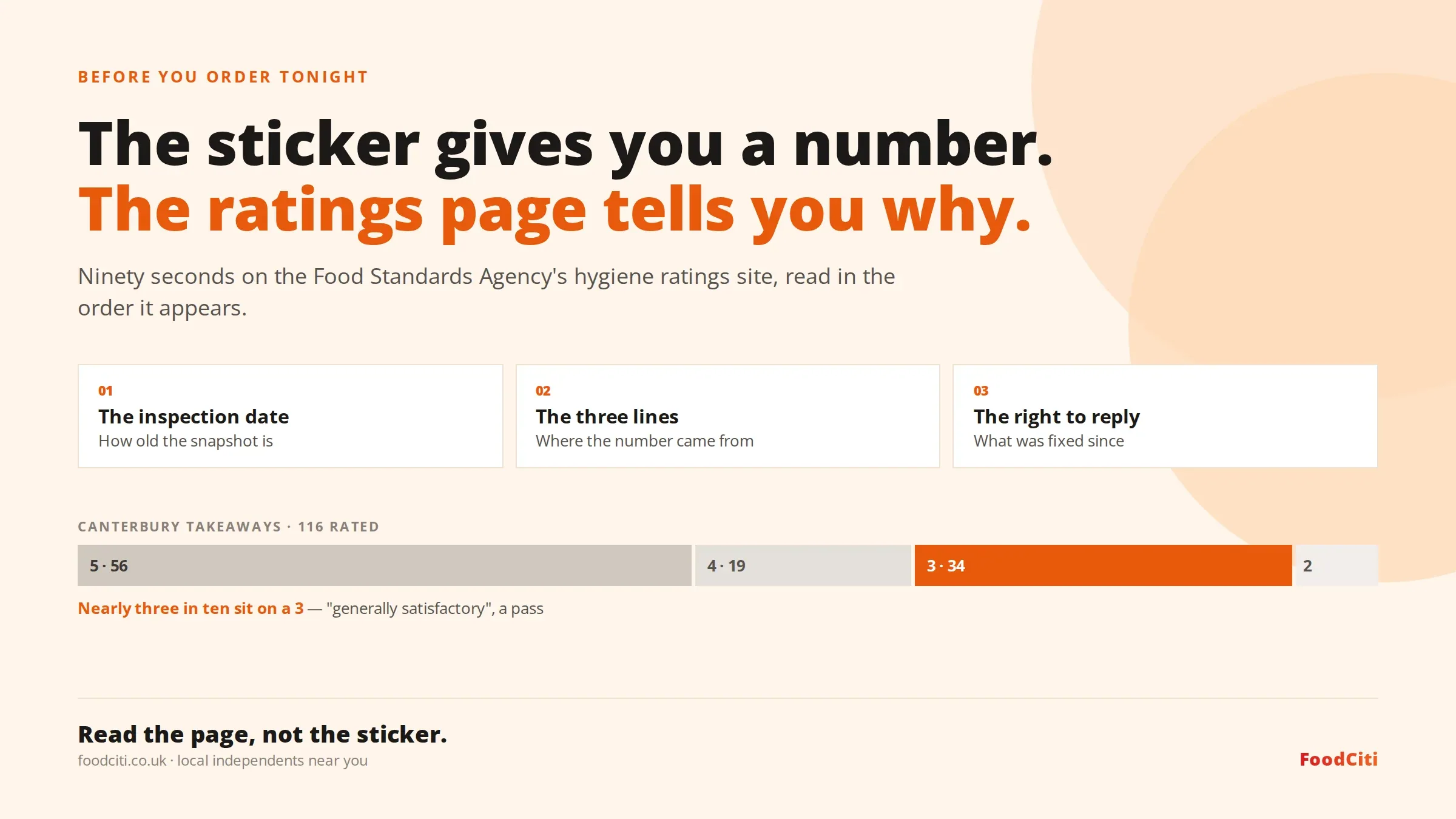
On 10 September 2026 we searched the register for takeaways and sandwich shops in the Canterbury City Council area. 116 had a rating: 56 were 5s, 19 were 4s, 34 were 3s and 7 were 2s. Nearly three in ten sit on a 3. Rule out every 3 and you rule out a lot of kitchens that passed.
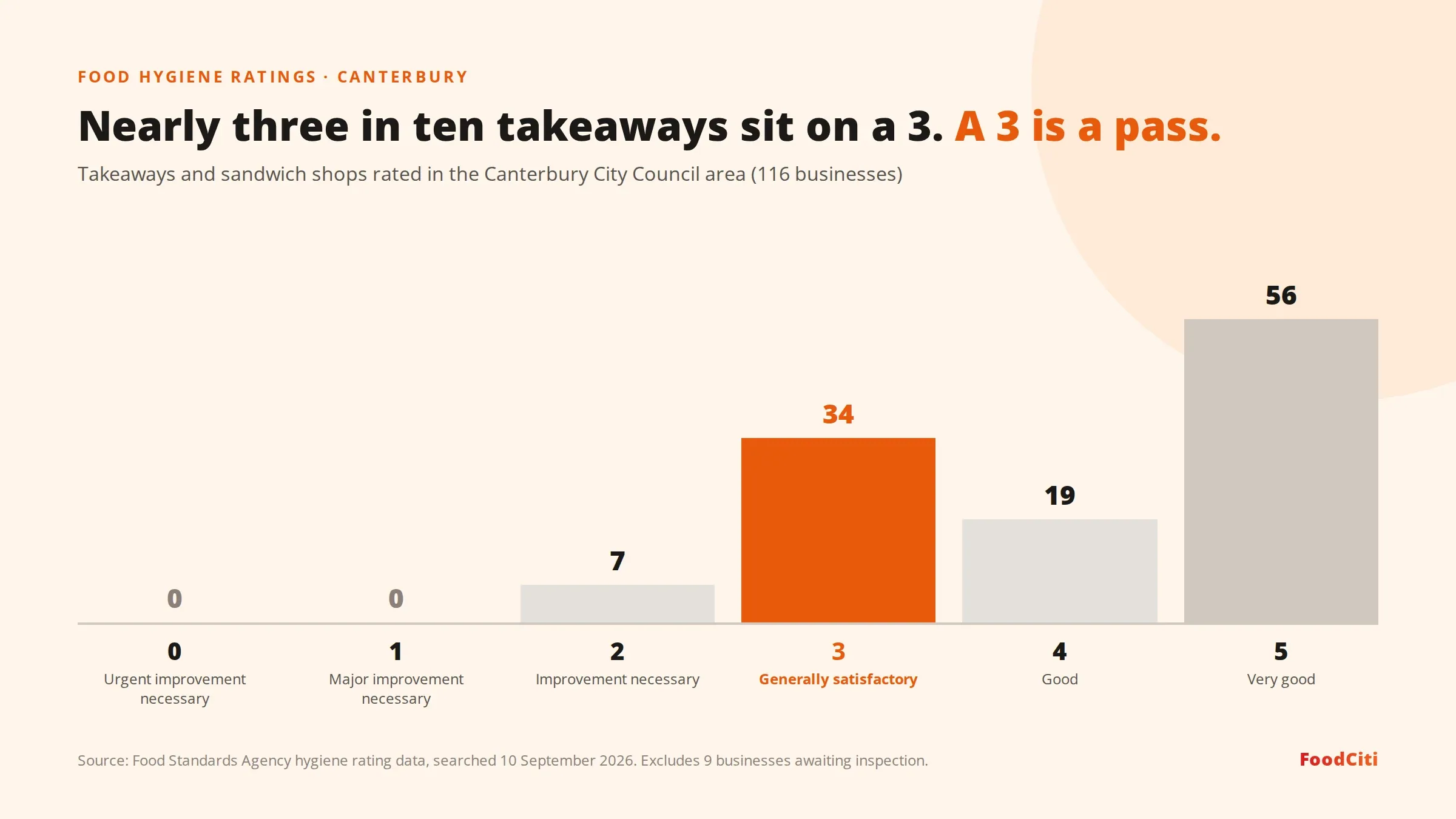
The number is also a summary of three separate judgements, and summaries hide things. For those, you need the page itself.
The date tells you how old the snapshot is
Search the Food Standards Agency's site, ratings.food.gov.uk, by the restaurant's name and postcode, and open its page. The first thing worth reading is not the rating. It is the date of inspection, just under the address.
A rating describes what the officer saw on one day. How soon they come back depends on how risky the council judges the business to be: every six months for the highest-risk places, every two years for lower-risk ones, and sometimes longer. In that Canterbury list, 12 of the 116 had last been inspected more than two years ago. The oldest visit was in September 2022.
An old date is not automatically a warning. Past hygiene standards are one of the things a council weighs when deciding how soon to return, so a long gap often means the last visit went well. What an old date does tell you is that the rating cannot know about anything since: a new chef, a new menu, a kitchen twice as busy. A 5 from last spring and a 5 from four years ago are two different amounts of evidence.
One detail on timing. A 5 is published as soon as the council uploads it, but a 0 to 4 waits three to five weeks so the business can appeal. If a page says "awaiting publication", an inspection has happened and the result is not public yet.
The three lines show where the number came from
Below the date is a short table headed "Standards found at the time of inspection". It has three lines:
Hygienic food handling: how food is prepared, cooked, reheated, cooled and stored.
Cleanliness and condition of facilities and building: layout, ventilation, handwashing, pest control.
Management of food safety: the checks and training in place, and whether the officer is confident standards will hold.
Each line gets its own word, from "very good" through "good" and "generally satisfactory" downwards. The FSA says a business has to do well in all three to get a 5, so a lower number means something was weaker, and this table tells you what.
That is where two identical numbers stop being identical. One 4 we found in Canterbury read "good" for the building, "good" for management and "generally satisfactory" for food handling. Another 4 on the same list was the reverse: "good" for food handling, "generally satisfactory" for the building. If what you care about most is what happens to your food between the fridge and the box, those are not the same 4.
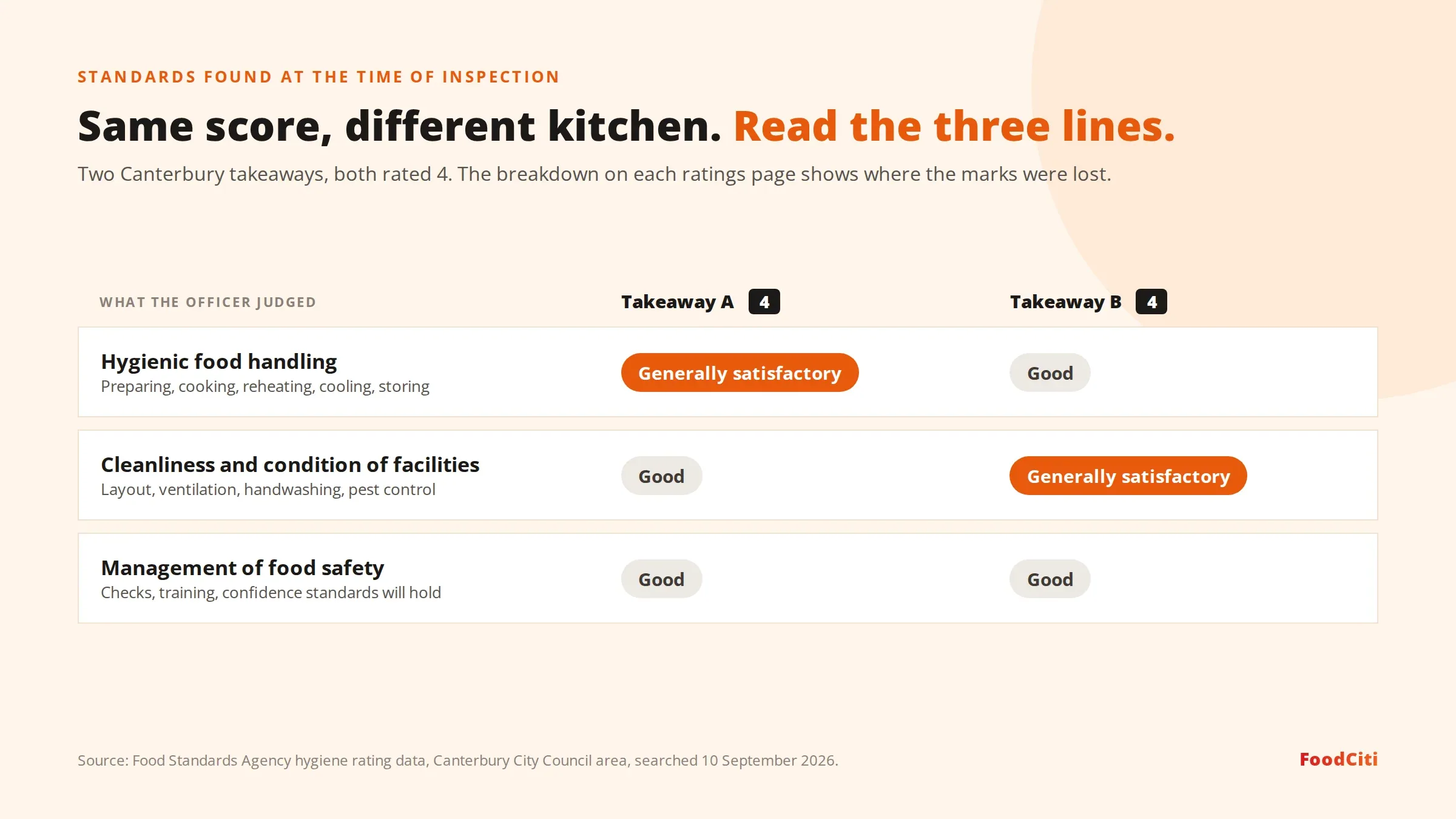
Not every page shows the breakdown. For 10 of our 116 it was missing. Most have it.
The reply and the report, if you want to go further
Businesses have a "right to reply", and if they have used it, their response is published next to the rating, often explaining what has been fixed since. A short, specific reply is a decent sign. It means someone read the inspection and did something about it.
You can also ask for the officer's report itself. The page gives the council's email address; occasionally they will decline, but they will tell you why. Nobody does this for a Friday takeaway. For a party order or a caterer, it is one email.
What the rating will never tell you
It is worth being straight about the limits. A hygiene rating says nothing about whether the food is good. Not taste, not portions, not value, not whether it arrives hot. A 5 can serve you a dull curry and a 3 can make the best chips in town. It judges the kitchen, not the driver or the bag, and it is only as current as its date.
So use it as a floor, not a ranking. Look up the places you order from most, look again when the date gets old, and let the menu and the reviews do the rest of the choosing.
Where FoodCiti fits
FoodCiti lists local independents: the kebab house, the fish bar, the curry house round the corner. Every one of them has a ratings page like the one above, and the restaurant's name and postcode are all you need to find it. We would rather you checked. A kitchen that looks after its hygiene has every reason to be glad you did.