There is no shortage of ideas for a quiet Tuesday. A set menu. A post on Instagram. A leaflet drop. A dish you only do midweek. Most kitchens have tried a few.
What there is a shortage of is checking. The usual test is to stand at the pass at nine o'clock and ask whether it felt busier. Then the next Tuesday it rains and the idea is dropped. Or the next Tuesday is busy for some unrelated reason, and a bad idea becomes permanent.
So this is not another list of midweek restaurant offers to try. It is how to find out whether the thing you tried did anything — and why the obvious number will nearly always say yes.
Tuesday is the cheapest night of the week to be wrong
Friday is the wrong place to experiment. The kitchen is at capacity, a mistake costs real customers, and there is no room to notice what changed.
Tuesday is the opposite. The fryer has space, the phone is quiet, and somebody has time to watch. If a change backfires, you have lost very little, because there was very little to lose. Your slowest night is the one night you can afford to try something properly — as long as "properly" means setting it up before you start.
Set it up so the answer cannot flatter you
Four rules. Skip any one and a busy-feeling Tuesday turns into a false conclusion.
Change one thing. A new set menu, a fresh leaflet run and an Instagram push in the same week is three experiments, and you will never know which one did the work.
Run it for four weeks, and compare it with the four weeks before — same night. Not with Friday, and not with last Tuesday alone. Four weeks a side usually catches a month-end payday in both and smooths out one wet night. If a bank holiday or school holiday falls in only one window, move it.
Write down, before you start, what would count as success. Put a number on it and stick it to the wall. After the fact, almost anything can be made to look like a result.
Make sure you can tell customers apart. You need a phone number or account on each order. Without it you can count orders but not see who placed them — and that, it turns out, is the whole answer.
Four weeks later: the number everybody looks at
Here is a worked example. The figures are illustrative; use your own.
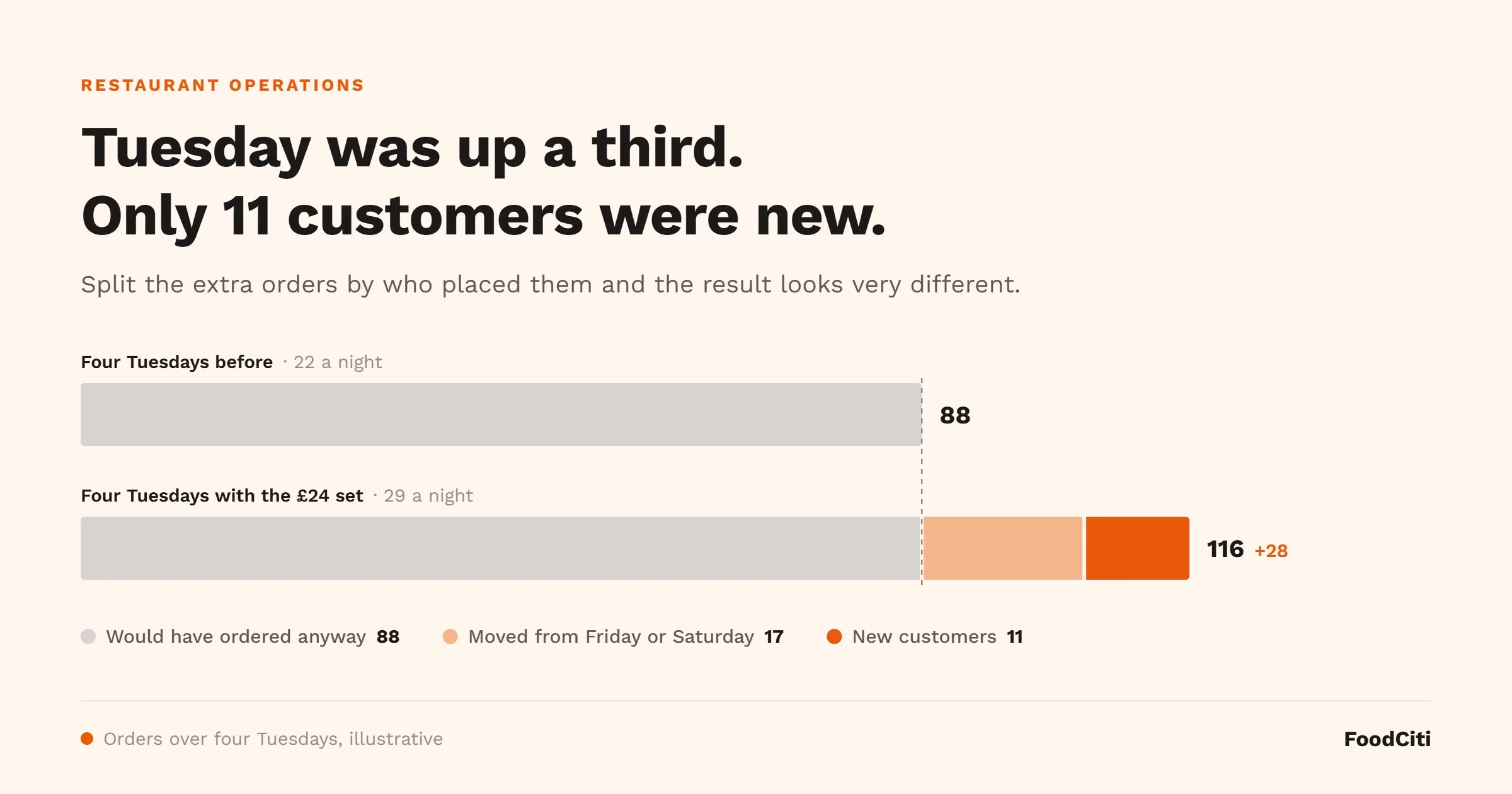
A takeaway does a steady but thin Tuesday. The four Tuesdays before the test brought in 19, 23, 21 and 25 orders — 88 in total, 22 a night.
The change: a Tuesday-only set for two at £24. Ordered separately, the same dishes come to £29, so the set is £5 cheaper. Nothing else changes — same menu otherwise, same opening hours, no extra promotion.
The four test Tuesdays bring in 27, 30, 26 and 33 — 116 in total, 29 a night.
That is 28 extra orders, seven a night, up almost a third. By the did-it-feel-busier test, the set becomes a fixture.
Now look at who placed them.
Split the orders by who placed them
Across the four weeks, 52 of the 116 orders were the set. Sort the people behind those 52 into three groups.
24 came from customers who were already Tuesday regulars — they had ordered on at least one of the four baseline Tuesdays. They would have ordered anyway. They simply ordered the cheaper thing.
17 came from customers whose usual night is Friday or Saturday. They did not order more often. They moved.
11 came from people who were new, or had not ordered for at least three months.
There is a quick way to check the split holds together. The 64 orders that were not the set, plus the 24 regulars who switched to it, come to 88 — exactly the baseline. The extra 28 orders are the 17 who moved and the 11 who were new. Nothing else happened.
What the split says about this particular offer
Take the three groups one at a time.
The 24 regulars are pure cost: up to £120 over the four weeks, handed to people who were coming regardless. "Up to", because a few might not have ordered those exact dishes at full price.
The 17 who moved are the interesting ones, and whether they are good news depends on your Friday. If Friday has spare capacity, you have sold 17 customers the same meal £5 cheaper on a different night: £85 gone, no new business. If Friday is full — long quotes, orders paused at 7.30, the phone ringing out — then moving 17 to an empty Tuesday frees room on the night that was turning people away. We went through what a saturated peak hour costs in our post on the 7pm hour. Same 17 orders, opposite verdicts, and the Tuesday numbers alone cannot tell you which one you have.
The 11 new customers are the only group that proves the offer grew the business. Eleven people in four weeks is fewer than three a night.
Put it against the cost. In discount alone, the set gave away 52 × £5 = £260 over the four weeks. The 11 new customers spent 11 × £24 = £264 between them. The offer cost, in money handed back, almost exactly what the new customers paid.
That does not mean it failed. It means "up almost a third" was never the result. The result is 11 new customers for about £260, plus whatever the 17 movers are worth to your Friday. That is something you can judge against the number you wrote on the wall.
What four Tuesdays cannot tell you
Eleven people is a small number. One office team discovering you can make or break a test this size. If the result lands close to your target, run another four weeks rather than arguing about it.
It cannot tell you whether those 11 come back — and a new customer who only ever orders the discounted set, only on a Tuesday, is a smaller prize than one who returns on a Friday at full price. That is the question that matters most, and we made the case for it separately. Check the 11 again in two months.
And it only tests the one change you made. If the set did little, that is not proof nothing works on a Tuesday — only that this did not. Change the next thing, keep the four rules, run it again. Five or six of these a year will teach you more about your quiet night than any list of ideas.
The part that needs a record
The rules are free and the maths fits on an envelope. The one part you cannot improvise is knowing who placed each order. On FoodCiti, orders that come through your own Online Ordering page arrive with the customer attached, and Telephonic Orders picks up the caller's number and order history as the phone rings, so phone customers are counted too, not just the ones who ordered online. Reports & Dashboard is where you pull the eight Tuesdays and split them. And because FoodCiti runs one menu across everything, the Tuesday set goes live on the website, the till and the phone screen in one change — and comes off the same way when the four weeks are up.
If a third party holds the customer relationship, the split above is not available to you at all. You get a count of orders, not people — we covered why that matters.
Pick one change. Write the number on the wall. Then wait four Tuesdays before you decide anything.