A two-star review lands at 11:04 on a Sunday night. Ordered at 7:20, arrived at 8:40, food was cold, second time this has happened. You read it on Monday morning with a coffee going cold next to you, you write back apologising, and you get on with the week.
That reply took you twenty minutes to word. It will change almost nothing — not that review, and not the restaurant reviews you get next month.
Not because replying is pointless — it isn't, and we'll get to it. But because by the time a review exists, the only decision left is a small one. The big decision happened weeks earlier, and it wasn't about that order at all. It was about who gets asked.
The same review, read by three different people
Look at that Sunday-night review again. Three people are going to read it, and they are reading three completely different things.
The person who wrote it is closing a loop on a feeling — a Sunday evening that went wrong, a family waiting, an hour and twenty minutes of checking the door. By the time they hit publish they have already decided about you. The review is a receipt for a mood, not a service report.
The person choosing dinner on Thursday is reading something else entirely. They will not read your average. They will glance at the number, then read the three most recent reviews and the worst one visible without scrolling. What they are looking for is not "was this place bad once" — everywhere is bad once. They are looking for a pattern. Two reviews mentioning cold food nine months apart is bad luck. Two mentioning it in the same fortnight is a decision.
The ranking systems are reading a third thing. They care about how many, how recent, and how steadily they arrive. A 4.9 built from eleven reviews, the newest of them fourteen months old, is a weaker signal than a 4.4 built from ninety with three from last week. A profile that stops collecting reviews starts looking closed.
So one bad review is three problems, and only one of them — the mood of the person who wrote it — is about the night it describes.
The people who write restaurant reviews are not your customers
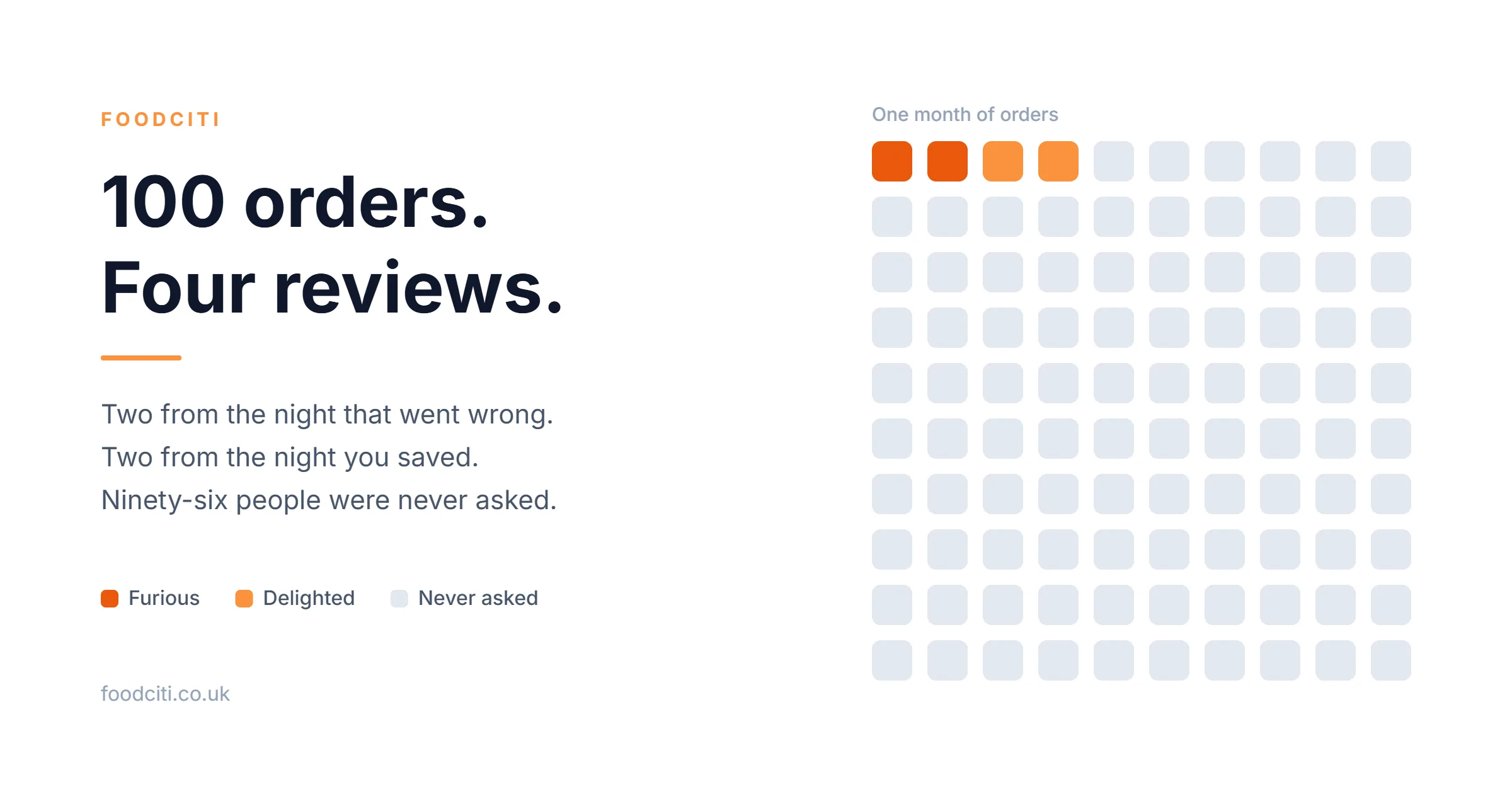
Here is the uncomfortable bit. Reviews are not a sample of your customers. They are a sample of your customers who felt something strongly enough to open an app about it.
Think about who that actually is. The person whose order arrived an hour and twenty minutes late. The couple whose anniversary you quietly saved by finding them a table. Both have enough energy to go and type. The other ninety-odd percent — the Tuesday regular, the man who has ordered the same mixed grill every other Friday for two years — feel nothing worth typing about. Fine does not generate energy.
Which means your public rating is not a measurement of your restaurant. It is a measurement of your restaurant filtered through the two moods that produce enough energy to leave the sofa.
You cannot do much about the furious end. You can do a great deal about the quiet middle, and almost nobody does, because it feels like begging.
Asking, without it feeling like begging
Four things decide whether an ask works.
Timing. Not the moment of payment — the moment of relief. In a dining room that is the beat after you drop the card machine and someone says "that was lovely", not while they are hunting for a coat. For delivery and collection it is roughly the hour after the food arrived, while they can still taste it. A message two days later asks them to remember something they have stopped thinking about, and it reads as admin.
Friction. Count the taps between the ask and the typing box. A QR code on the box that opens your review page directly is one. A QR code that opens your homepage, from which they have to find the review link, is three or four — and roughly speaking every extra tap halves what you get. If you are printing anything, print the direct link.
Words. "Please leave us a review" is a request from a business. Name the specific thing instead: "if the lamb chops were right tonight, would you mind saying so?" It gives them the first sentence, which is the part people stall on, and it sounds like the person who cooked it rather than a system.
What not to do. Do not offer anything in exchange — a free side, a discount, entry into anything. Google's review policies prohibit incentivised reviews, and readers spot them anyway, because incentivised reviews all read the same. And do not ask only the people you already know are happy. Filtering who gets asked is against the same policies, and it is fragile: it works until the one time you misjudge someone.
Ask everyone, at the right moment, with one tap. That is the entire technique.
The one number worth counting
Not your rating. Your ask rate: reviews received last month, divided by orders last month.
Most independents have never worked it out, and the answer is usually startling. Take an illustrative month — 900 orders, 9 new reviews. That is an ask rate of 1%, and none of those nine were asked; they arrived under their own steam, which is exactly why they cluster at the extremes.
Now suppose you ask on 300 of those orders and 8% of them respond. That is 24 reviews from the quiet middle. Run the average: eleven existing reviews at 4.2 is 46.2 points. Add 24 at 4.7 and you add 112.8. Total 159 across 35 reviews — 4.5, and climbing, from people who describe an ordinary good Tuesday rather than a catastrophe or a rescue. (Illustrative figures — put your own in.)
You did not argue with a single bad review. You diluted it, and you fixed the recency signal at the same time.
Then reply — but not to the reviewer
The reply is public, and the reviewer has already moved on. You are writing for the person reading it on Thursday, who wants to know one thing: is this fixed, or is this what happens here?
Three lines does it. Name the specific failure so it is clear you read it. Say what actually changed — a prep-time setting, a delivery radius, a second person on the phones on Fridays. Stop. No paragraph of policy, no "please contact us directly" as the entire reply, and never an argument about what really happened, however wrong they are. An owner who argues in public reads worse than the original complaint.
And if you genuinely fixed the thing, say what you fixed. "We had the prep time set fifteen minutes short on Sundays. It isn't now." That sentence sells more Thursdays than any apology.
The fixes worth naming are almost always the dull operational ones — a prep time, a radius, a person on the phones on Fridays. We put numbers on what those failures actually cost in the refund is not the expensive part.
Where FoodCiti fits
You can only ask people whose details you have. That is the quiet reason this whole thing lives or dies on how your orders come in.
Orders through your own Online Ordering page bring the customer with them — the contact, the order history, the timing. Telephonic Orders with caller ID does the same for the phone regulars who have never once ordered online. Reports & Dashboard shows you which services actually went well, so you know which nights are worth asking on.
None of that writes a review for you. It just means the ask can go to the right person, at the right hour, with one tap — instead of going to nobody, which is what happens now.
See how it works for your restaurant → https://foodciti.co.uk/partner