Two numbers on your ordering page were almost certainly set in the same ten minutes, somewhere in your first fortnight of trading. How far you deliver. How long you tell people it will take.
Neither has been touched since. Both are still making decisions about your Friday nights, every week, and not always in your favour.
They are worth an hour of a Tuesday afternoon, because they are two of the very few levers in this business that change a busy night without anybody working harder.
The radius is not a question about customers
A delivery radius looks like a question about who is allowed to order from you. More map, more customers, more orders. It is easy to treat it as a marketing setting and be generous with it.
It isn't a marketing setting. It is a question about your driver's time — and your driver's time is what decides how long everybody else waits.
Your kitchen does not slow down when an order comes in from four miles away. Your delivery does. And not for the person four miles away. For the six people who ordered while the car was out there.
Sort last month by distance, then price it in minutes
Pull last month's delivery orders and band them by distance. Three bands is plenty. Then put your own round-trip time against each band — not the map's estimate, the real one: leaving, driving, finding the flat, getting back on the road.
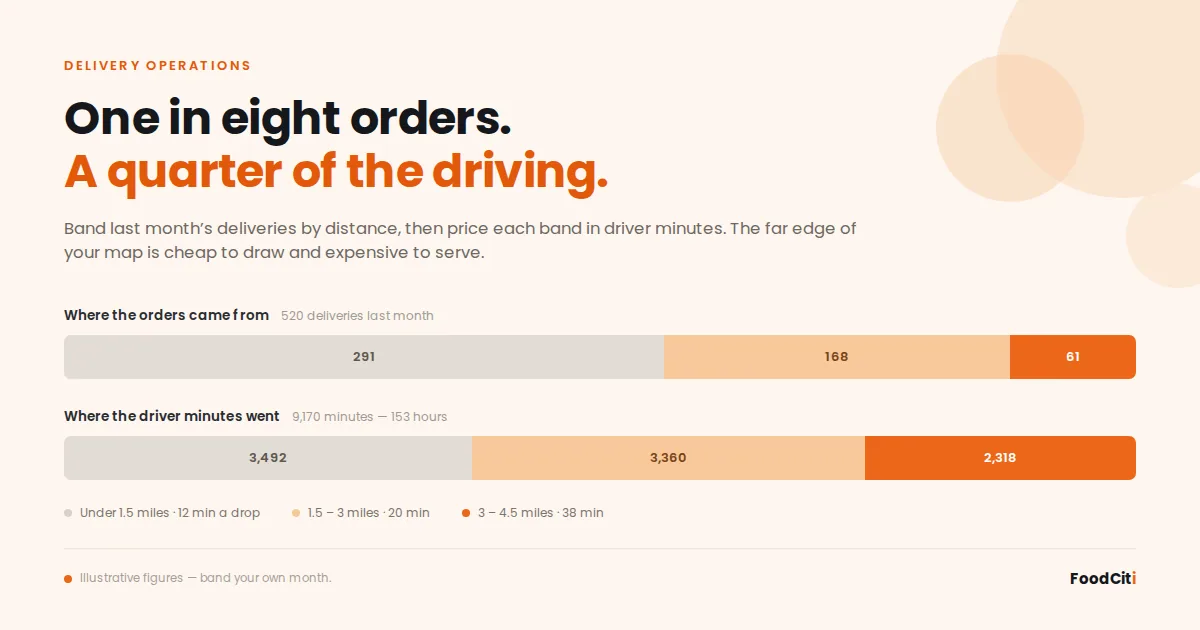
An illustrative set, so the shape is visible — use your own numbers.
Say last month brought 520 delivery orders. 291 came from inside a mile and a half, and a drop in that band takes about 12 minutes door to door. 168 came from the mile-and-a-half to three-mile band, at roughly 20 minutes each. And 61 came from the far edge — three to four and a half miles — at about 38 minutes each, because that is where the traffic, the estate you can never find and the phone call all live.
Multiply it out. The near band costs 3,492 driver minutes. The middle band, 3,360. The far band, 2,318.
So the far edge of your map is under one order in eight, and just over a quarter of all the driving you paid for. Across four weeks that is more than 38 hours of somebody's time — close to ten hours a week — for about fifteen orders a week.
Your counts and your minutes will be different. What rarely changes is the shape, because a longer run is not simply a longer drive. It is a drive with more unknowns in it.
One run to the edge costs you three near the door
That is the number that should actually change a decision.
In the 38 minutes one far order takes, the same driver could have completed three of the near ones.
This is where the bill lands on the wrong customer. While the car is at the edge of the map, the orders from half a mile away are not being delivered. They are sitting bagged on the pass, losing heat at the fastest rate they ever will. Nobody at the far edge experiences that as a cost. Your regulars do, and they experience it as you getting worse.
The quoted time is the same setting wearing a different hat
You cannot quote two different times in one box. So whichever single number sits there has to cover your worst case — which is the far edge of your map, on your busiest night.
Which means the customer 0.8 miles away, who orders every other Thursday and could genuinely have had his food in twenty minutes, is reading a forty-five minute quote. Some Thursdays he reads it and orders somewhere else — an order you never see, lost to a setting.
Quote for him instead and the far orders are late every single time. They already have the longest wait and the coldest food, and — this is the part that stings — they are the ones writing the review at 23:04.
A check you can run on last Friday: take the orders placed between 19:00 and 20:30 and compare what you quoted against when each one actually landed. Count how many were more than ten minutes over. If it is more than one in five, the quote is not a promise, it is decoration, and your customers worked that out before you did.
Neither number should be one number
The real mistake is rarely a radius that is too wide or a quote that is too short. It is that both are a single value covering every hour of every day.
A Tuesday at 8pm and a Friday at 7.15pm are not the same business. On Tuesday the car is idle and four and a half miles is close to free money — the driver was going to be sitting there regardless. On Friday, the same four and a half miles takes your only driver off the road for the best part of forty minutes at the exact moment the pass is stacked.
Giving the two dials a timetable is a different move from cutting your delivery area. You are not shrinking the business. You are refusing to let the quietest part of your map run the busiest part of your week. It is also the decision that makes the three moves left at 19:40 less necessary, because you made it on a Tuesday afternoon instead of in the middle of service.
Four things to do with the two dials
Band last month and price each band in driver minutes. Counts alone will mislead you. The far edge always looks harmless as a share of orders and rarely looks harmless as a share of hours.
Put your peak radius where the minutes stop paying. Not where the map looks tidy. If a band is taking a quarter of your driving for an eighth of your orders, that band is the candidate — on Friday, not on Tuesday.
Quote to the edge you actually serve, and then beat it close to home. A forty-five minute quote you hit at twenty-eight minutes is a customer who orders again. A thirty-minute quote you miss by fifteen is a refund conversation.
Try a minimum order on the outer band before you cut it. Some of those runs are worth thirty-eight minutes. The small ones almost never are, and a floor sorts them without you having to redraw anything.
Then put a date in the diary to look again. A new estate, a driver leaving, a competitor opening on the ring road — all of them move the line, and none of them will tell you.
What FoodCiti does about it
Most of this is a decision rather than a feature. No software can tell you where to draw your own line.
What software can do is put the two dials somewhere you control and last month's orders somewhere you can actually read. Online Ordering keeps the delivery area and the quoted time on your own branded page, yours to change on a Tuesday afternoon rather than inherited from a setup call. Reports & Dashboard is where last Friday is recorded rather than remembered, which turns the banding exercise above from archaeology into half an hour. Telephonic Orders and the EPOS Till keep intake moving while you do it, and they work offline.
Setup and training are on us and the first month is free — which is, conveniently, about one clean month of distance data to band.
The radius and the quote are the two settings your customers feel most and you look at least. Go and look at them.
See how it works for your restaurant →
Task #1
Task #2
Task #3
Task #4
Restaurant Peak Hour: Why Going Faster Won't Fix Ithttps://foodciti.co.uk
Foodciti