Ask most owners where the money leaks and they will talk about delivery platforms, food cost, staff hours. Very few will talk about the room they already own, on the night it is already full.
Which is strange, because the dining room is the one part of the business where you keep everything. No commission, no rider, no packaging, no third party between you and the person spending the money. A cover you seat at eight o'clock is worth more to you than a cover you deliver at eight o'clock — and it costs you nothing extra to seat it.
As long as the table is free at eight o'clock.
That last clause is where the money is. So here is one Friday, one room, told by the clock instead of by the food. Not a horror story — a normal service, run by people who know what they are doing.
18:42 — two people at the door, and nobody can answer them
A couple walks in. "Have you got a table?"
Whoever is nearest looks at the diary, looks at the room, and does the sum in their head: table 7 is finishing, table 3 has been on coffees a while, there is a four-top booked for seven but that is a four-top. The honest answer is "probably twenty minutes, maybe more." What comes out is "sorry, we're fully booked tonight."
They were not lying. They just could not see the room clearly enough to say yes, and saying a soft yes that goes wrong costs more than saying no. So the couple leaves and the table they would have had sits empty at 18:55.
The cost of a paper diary is not the paper. It is that it only tells you about the bookings, and most of the room on a Friday is not bookings.
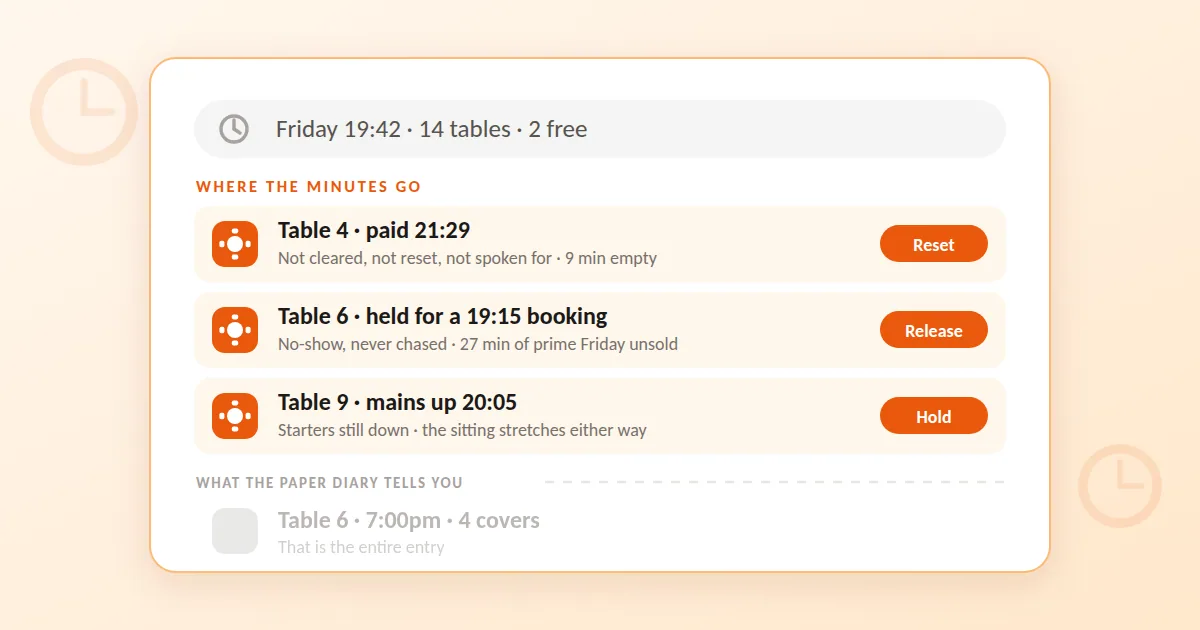
19:15 — the table you are holding for someone who is not coming
Table 6 is laid for four at seven. At quarter past, they still are not here. Nobody has called.
You hold it, because you always hold it, because the one time you did not they walked in at 19:25 apologising about parking. So it sits — laid, lit, and earning nothing — until somewhere around half past when a member of staff finally says out loud what everyone has been thinking.
Twenty-seven minutes of prime Friday, gone. Not to a competitor. Not to a delivery app. To a diary entry that nobody chased.
The fix is not a stricter policy. It is a confirmation the guest actually sees, a reminder that lands a couple of hours before, and a single tap that puts the table back into the room the moment you release it — with a waitlist that already knows who to text.
20:05 — the mains arrive while the starters are still down
Table 9 ordered together, so the kitchen fired together. The starters went out at 19:52 and the mains are ready at 20:05, which would be fine if anyone at table 9 had finished a starter.
Now you have a choice nobody enjoys. Hold the mains under a lamp and serve them tired, or land them on a table that has nowhere to put them and watch four people eat in a rush they did not ask for.
Either way the sitting stretches. Either way somebody remembers the evening as slightly off, without being able to say why.
Course timing is not a chef problem or a waiter problem. It is a communication problem, and it belongs on the same screen the order was taken on.
21:20 — "can we split it four ways?"
The meal went well. The bill takes eleven minutes.
One card for the wine, two people splitting the food, one paying cash and wanting change. The till was not built for it, so it becomes arithmetic on a docket, three trips to the counter, and a queue behind you at the card machine while a table that finished five minutes ago waits to do the same thing.
Nobody complains about this. They just sit there while it happens, taking up a table that could have started earning again at ten past.
21:29 — the nine minutes nobody owns
The card machine beeps. Four people put their coats on, say goodbye at the door, stand outside for a minute finishing a conversation.
The table is not cleared yet, because everybody is mid-something. When it is cleared it is not reset, because the cloths are at the other end. When it is reset, nobody is sure whether it is spoken for.
Nine minutes. Sometimes fifteen. It happens after every single party, at every single table, all night, and it is the only part of the evening that nobody in the building is responsible for.
What the evening actually added up to
None of the above is bad service. It is a room without a live view of itself.
Run the arithmetic on one table, and treat these as illustrative numbers — swap in your own.
Service runs 17:30 to 22:30, so each table has 300 minutes to sell. A typical sitting is about 75 minutes. Add the dead time — clearing, resetting, holding, hesitating — and call it 15 minutes between parties. That is a 90-minute cycle, so the table turns 3.3 times.
Now take the dead time down to 6 minutes and stop holding no-shows past their grace period. The cycle drops to roughly 78 minutes and the same table turns 3.8 times.
Half a seating per table. Across a fourteen-table room, that is about seven extra parties on a Friday, at no extra rent, no extra chef, and no extra marketing spend. Put your own average party spend against that number and you will see why this is the least glamorous and best-paid work in the building.
The one number to count next Friday
Do not audit the whole service. Count one thing.
Give one person a notepad and ask them to write down, for every table that leaves, the minutes between the card machine beeping and the next party sitting down. Just that. Ten or twelve rows is enough.
Most rooms are shocked by the average, and more shocked by the spread — the 4-minute turnaround and the 22-minute turnaround happen on the same night, at the same tables, with the same staff. The gap between them is not effort. It is information.
What FoodCiti does about it
Dine-in is half of what we build, and it runs on the same system as everything else:
Online bookings with auto-confirmations, so the 19:15 no-show gets chased before it becomes 27 empty minutes
A drag-and-drop floor plan and a live diary, so the person at the door can see the room instead of guessing at it
A waitlist with SMS callbacks, so the couple you turned away at 18:42 gets a text at 19:05 instead of eating somewhere else
Course timing and split bills built into the till, so 20:05 and 21:20 stop costing you minutes
Dine-in, phone and online orders on one device, off one menu, with one place to change a price
All of it on a flat monthly fee with 0% per-order commission — which means the extra half-turn you find is entirely yours.