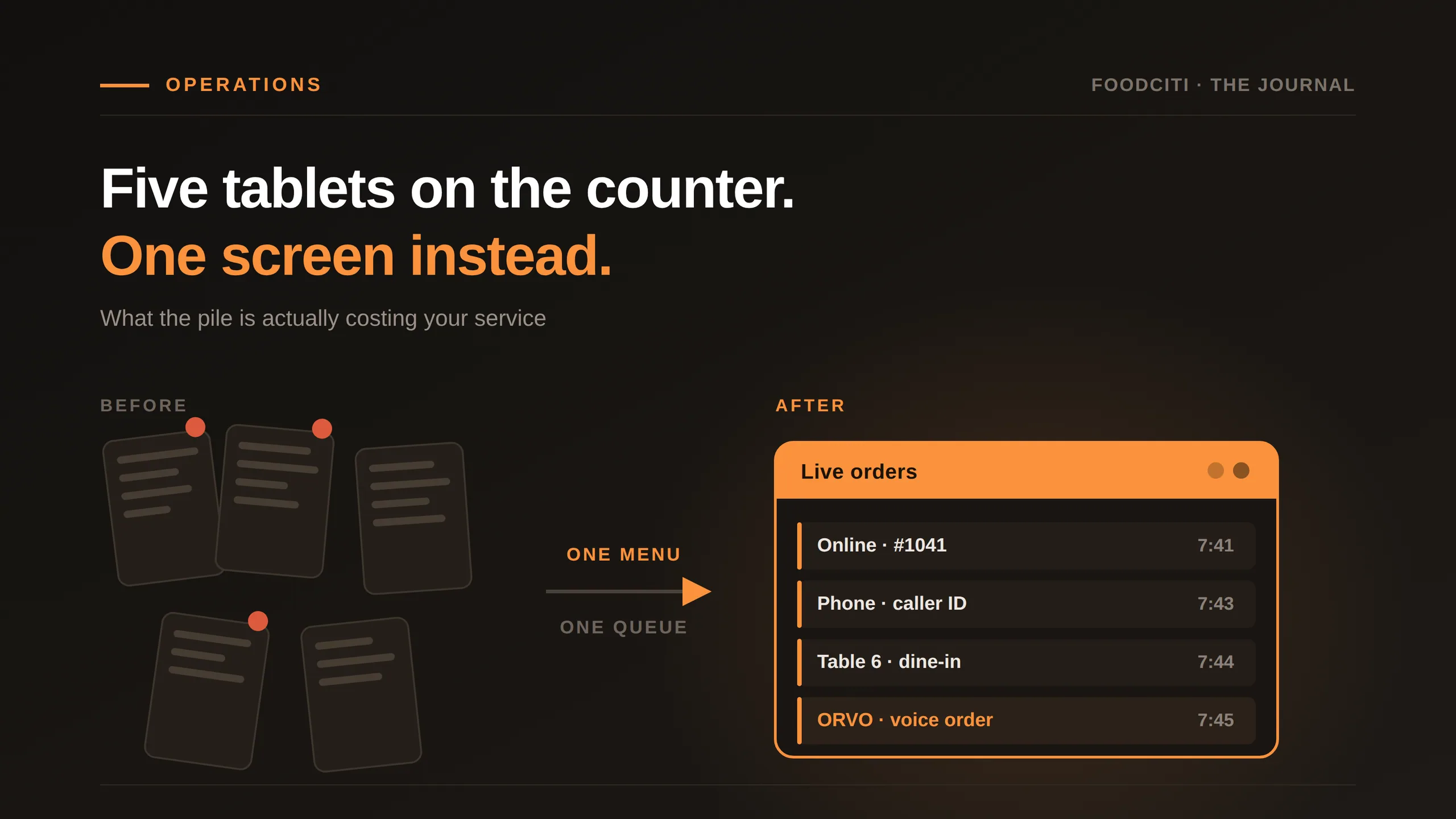
Nobody buys a tablet pile on purpose. It accumulates — one per platform, one for the phone, one for the till — and every single one adds a job that a person has to do while the kitchen is full.
The counter tells the story
Walk into most independent takeaways at 7:40 on a Friday evening and you can read the entire operating model off the counter.
A tablet for one aggregator. A tablet for another. A third for the platform you signed up to last spring and half-forgot. The till. A phone, ringing. Somewhere under a receipt roll, a printer that only speaks to one of them.
None of that was a decision. Each device turned up on its own, solved one problem on the day it arrived, and stayed.
The cost never appears on an invoice. It appears in the seconds lost re-keying each order, in the dish you forgot to mark unavailable on the third platform, and in the customer sitting on hold while somebody works out which screen is chiming.
Every screen is a separate job
A tablet is not a piece of equipment. It is a small ongoing responsibility, and it multiplies.
Each one has to be watched, because a missed chime is a missed order. Each one has its own menu, edited separately when the price of chicken moves. Each one produces its own end-of-day report, in its own format, reconciled against the till by hand. Each has its own prep-time setting and its own idea of what "busy mode" means.
One screen is a tool. Five screens is a job — and it is a job you are doing during service, at the exact hour when nobody has a spare hand.
The re-keying maths
Here is the part worth pricing, because you can do it with a stopwatch rather than a spreadsheet.
Take one order that arrives on a platform tablet and has to be typed into the till so it reaches the kitchen and the day's takings. Call it 40 seconds end to end — read the screen, key the items, hit send, check it printed. Some are faster. The ones with three modifiers and a note about no coriander are much slower.
Now say 60 of your orders a night arrive that way across the platforms.
That is 40 minutes of staff time every single night, spent typing information a computer already has. Over a six-day week it is four hours. Over a year it is roughly 200 hours — five full working weeks of somebody standing at a counter re-typing orders.
At £12 an hour that is roughly £2,500 a year in wages. But the wage figure is the smaller half. Those 40 minutes are not spread evenly across the evening — they land in a heap between 7 and 9, which is precisely when the person doing the typing should be plating, answering the phone, or looking after the four people who just walked in.
Menu drift is the quiet one
Ask most operators when they last checked that every platform is showing the same prices, and the honest answer is a shrug.
It is not carelessness, it is arithmetic. Five menus, each edited by hand, each needing an update whenever a supplier price moves or a dish comes off. Sooner or later one of them is out of date — and the version people can actually see is the one you forgot.
Drift costs money in three ordinary ways:
You sell a dish at last season's price on the one platform you did not update.
A customer orders something you stopped making in March, so you ring them back to offer a refund or a substitute.
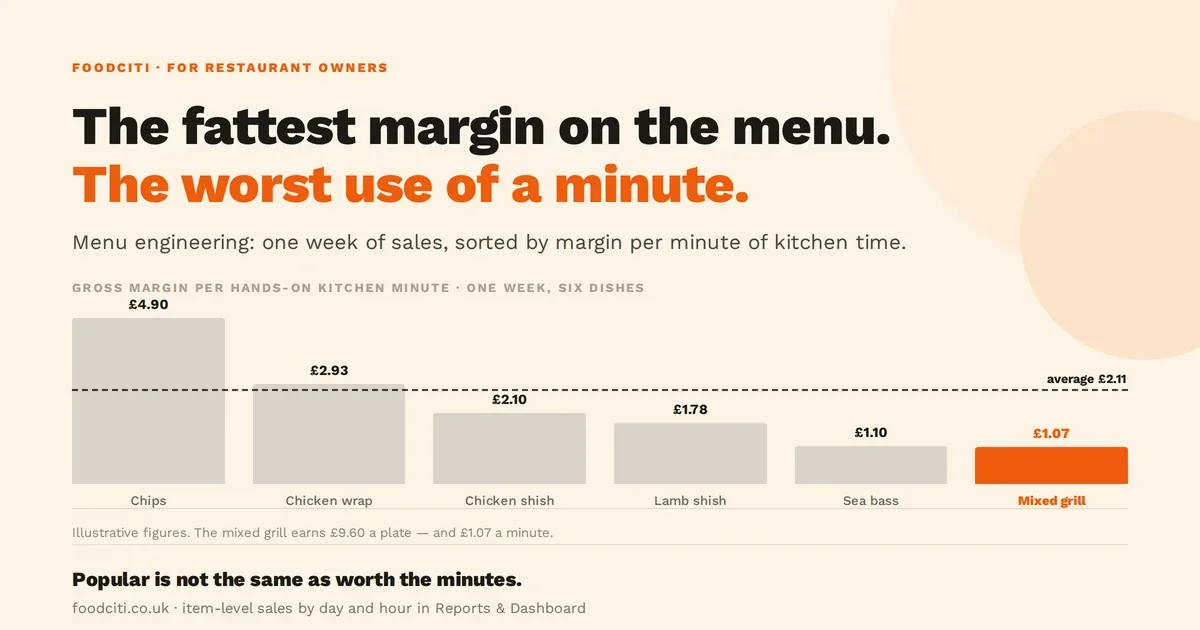
Your best-margin dish sits at the bottom of one platform's list because its category order is different and nobody has looked since setup.
Each incident is small. That is exactly why it never gets fixed.
What actually breaks first
The thing that gives way on a bad Friday is almost never the kitchen. Kitchens are good at being busy. It is the counter.
Somebody is on the phone taking an order by hand while two tablets are chiming and the person who knows which is which is in the walk-in. That is when an order gets acknowledged but never sent to the pass. That is when a customer waits 50 minutes for food that was never started, leaves a two-star review about it, and never orders again.
You do not lose that customer because the food was bad. You lose them because the information about their dinner was sitting on the fourth screen along.
Five screens against one
Five screens | One screen | |
|---|---|---|
New order arrives | Chimes on one of five devices; someone identifies which | Lands in one queue, in order of arrival |
Getting it to the kitchen | Re-keyed into the till by hand, ~40 seconds | Already there — no re-keying |
Changing a price | Edited separately in up to five admin panels | Changed once, everywhere |
Marking a dish off | Repeated per platform; easy to miss one | One toggle |
End of day | Several reports reconciled against the till | One set of figures |
Phone orders | Written on paper, keyed in later | Caller ID pulls up the customer, order goes straight in |
Work out your own number
You do not have to take any of the above on faith. Two figures give you most of the answer.
One. Tomorrow evening, time yourself re-keying five orders from a platform tablet into the till. Take the average, multiply by the number of orders that arrive that way in a night, then by your trading days, then by your hourly wage cost. That is the floor — the part you can prove.
Two. Open every platform you are live on and compare your five best-selling dishes: price, description and availability. Count the discrepancies. If the answer is zero, your admin is genuinely excellent. If it is not zero, that is what a manual process looks like when it is running normally.
Neither number includes the order you dropped last month, because that one is unmeasurable. It is also usually the most expensive.
What FoodCiti does about it
FoodCiti was built for the counter, not the boardroom. Everything lands in one place.
Online orders, walk-ins on the EPOS, dine-in tables and telephone orders all arrive in a single queue on a single screen. Phone orders come with caller ID, so a regular's details and usual order appear before you have finished saying hello. Behind it there is one menu: change a price once and it changes everywhere — your ordering site, the till, the app, the lot. Reporting sits in a mobile app, so you can check the day's numbers without going back to the office.
Ordering also runs through ORVO, our voice tool, so customers can simply say what they want and have it land in the same queue as everything else.
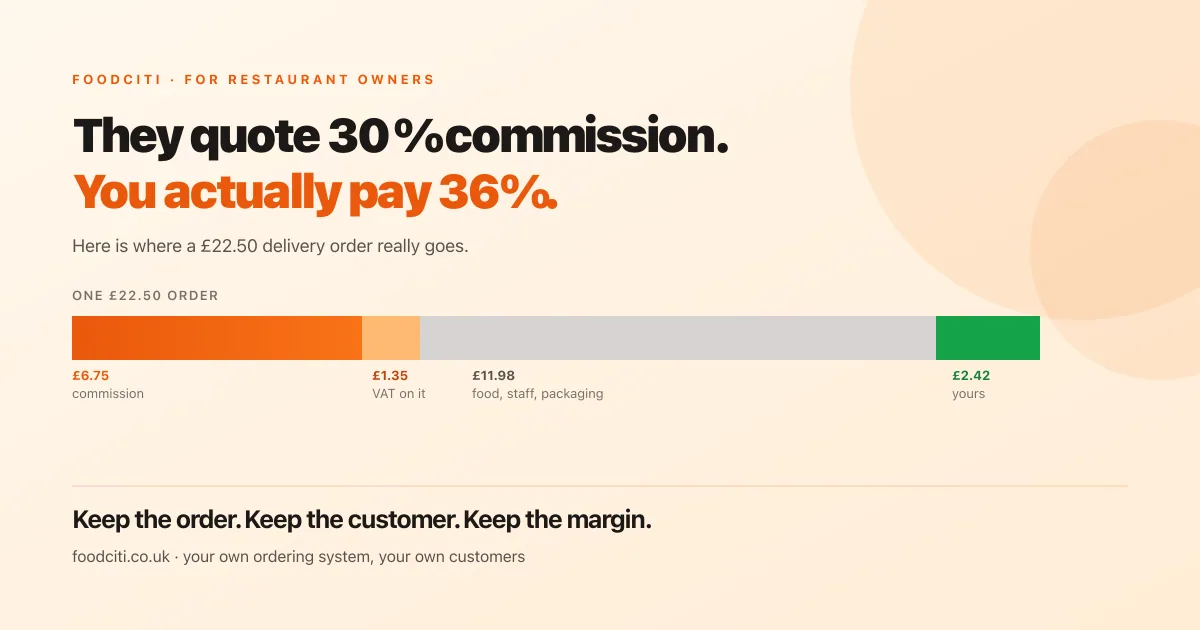
The commercial model is deliberately dull: a flat monthly fee and 0% commission, so a busier week does not cost more to run. For the arithmetic on what commission takes out of an order, we did that in detail in what a £22.50 order really costs you.
Setup takes about 48 hours, and you can cancel any time.
See how it works for your restaurant →


Track tools and referenced files used in this task.