
Ask most restaurant owners about Deliveroo commission and you will get a number: 30%. It is the figure in the contract, and it is the figure everyone quotes.
It is also not what leaves your bank account.
This is the arithmetic on a single order, done properly. It takes about four minutes to read, and it is the calculation most owners have never actually sat down and worked through.
Start with one real order
A customer orders £22.50 of food. Nothing unusual — a main, a side, a drink. Here is what happens to it.
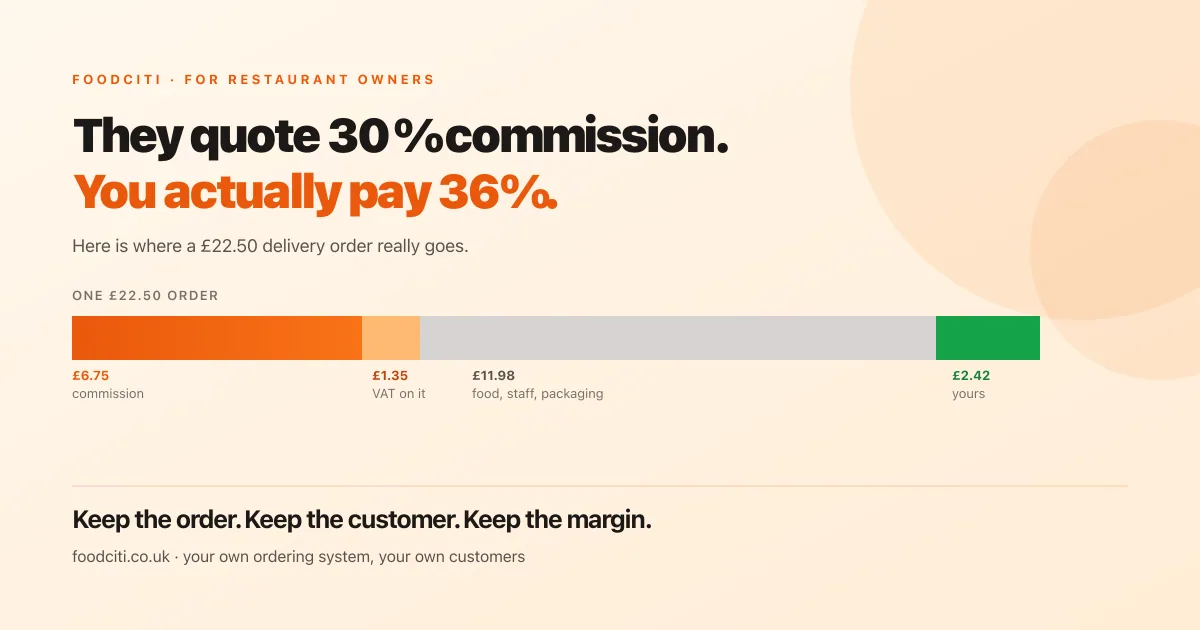
Commission at 30%: £6.75. That is the number in the contract, charged on the food total.
VAT on the commission: £1.35. This is the part that catches people. The platform's commission is a service they sell you, so it carries 20% VAT like any other service. If you are VAT-registered you can reclaim it, but it still leaves your account first — and if you are below the threshold, you cannot reclaim it at all.
So the deduction is £8.10, not £6.75. On a £22.50 order, that is an effective rate of 36%.
Now take out the cost of actually making the food
Commission comes off the top. Your costs are still to come.
Take a fairly typical independent: food cost around 30% of the menu price, plus the kitchen labour to cook it, plus packaging that delivery orders need and dine-in does not. Call it £11.98 across the three.
Here is the whole order:
Where it goes | Amount |
|---|---|
Order value | £22.50 |
Platform commission (30%) | −£6.75 |
VAT on that commission | −£1.35 |
Food, kitchen labour, packaging | −£11.98 |
What you keep | £2.42 |
£2.42. Just under 11% of the order.
The platform takes more than three times what you do, for an order your kitchen cooked, your staff packed, and — very often — a customer who already knew your name.
Why the headline number is always low
Four things sit outside the commission percentage, and all four cost money.
VAT on the commission. Adds a fifth on top of whatever rate you agreed, so a 30% Deliveroo commission is a 36% deduction in practice.
Commission is charged on the food total, not your profit. On a high-margin item you can absorb it. On a thin-margin one — anything where ingredients are expensive — the platform can genuinely take more than you keep.
Promotional spend. Discounts, sponsored placement, "free delivery" campaigns: these come out of your payout, and they are easy to switch on and forget.
Orders you would have had anyway. This is the one nobody puts in a spreadsheet. When a regular who has eaten with you for years orders through an app because it is on their phone, you pay 36% to serve a customer you already had. The platform did not find them. It just stood between you.
The part that costs more than the commission
Here is the thing the percentages hide entirely.
When someone orders through a marketplace, they are not your customer. They are the platform's customer. You do not get their email. You do not get their phone number. You cannot tell them you have opened on Sundays, or that the new menu is live, or offer them anything on their birthday.
Next time they are hungry, they open the app — not your website. And the app shows them whoever paid for the top slot that week.
You are renting access to your own regulars. That is the real cost, and it compounds every year you stay on that footing.
What the alternative actually looks like
Not "delete the apps tomorrow". For most restaurants that is bad advice — marketplaces genuinely do bring new customers, and discovery has real value.
What changes the maths is having somewhere to send people once they have found you.
An ordering system on your own domain means the same £22.50 order looks like this instead: no commission, no VAT on commission, just a card processing fee of roughly 1.5% plus 20p — around 54p. You keep about £9.98 instead of £2.42.
That is the same food, the same kitchen, the same customer. The difference is who owns the relationship.
The realistic play most operators land on:
Keep the marketplaces for discovery. Let them do what they are good at — putting you in front of people who have never heard of you.
Own the repeat business. Put your ordering link on the receipt, the packaging, the window, your Instagram bio, your Google Business profile.
Give people a reason to switch. A small discount for ordering direct costs you a fraction of 36% and moves a customer permanently onto your side.
Keep the data. Once you have the email address, a quiet Tuesday is something you can actually do something about.
Work out your own number
Take last month's delivery revenue. Multiply by your Deliveroo commission rate, then add 20% of that for VAT. That is what the platforms took.
Now multiply the same revenue by 0.02 — roughly what card processing costs on a direct order.
The gap between those two figures is what a direct ordering channel is worth to you annually. For most independents doing meaningful delivery volume, it is not a small number, and it is usually the difference between a difficult year and a comfortable one.
What FoodCiti does about it
FoodCiti is an ordering system that runs on your own domain, with your branding, and no commission on orders. Your customers, your data, your margin.
It also puts every order — online, till, and dine-in — into one queue, so the kitchen is not reading tickets off three devices and nobody is re-typing an order that arrived on a tablet. Reservations, delivery dispatch, loyalty, stock and reporting sit in the same system rather than in five.
Restaurants running it serve their regulars through their own front door and use the marketplaces for what they are actually good at: meeting new people.
See how it works for your restaurant →
Figures use a 30% commission rate and standard UK VAT at 20%. Your own rate is in your platform contract and is often negotiable — the arithmetic works the same whatever number you put in.